

Aliyev’s ‘Realpolitik’ vs. Pashinyan’s ‘Legal’ Approach: A Clash of Ideologies in the South Caucasus
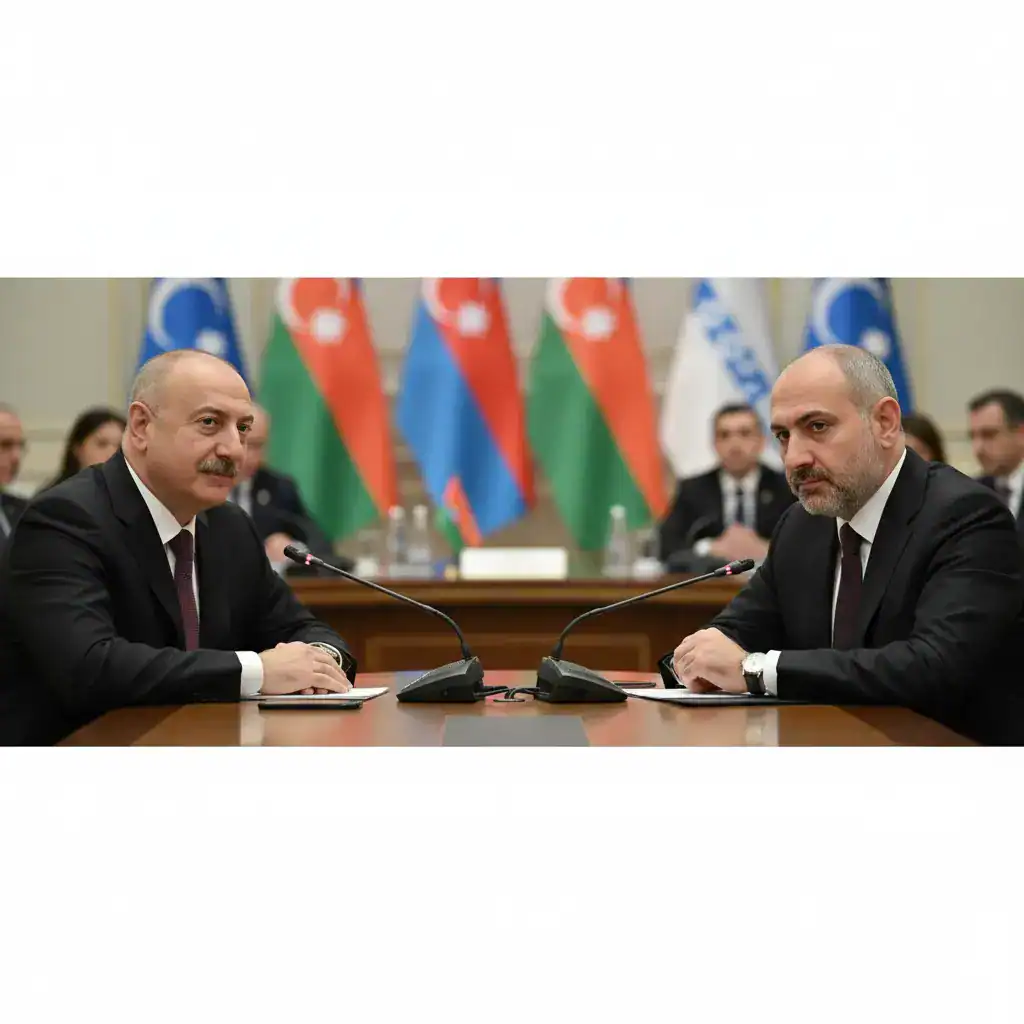
Political analyst Suren Surenyants has offered a scathing critique of the divergent strategies employed by Azerbaijani President Ilham Aliyev and Armenian Prime Minister Nikol Pashinyan in addressing the complex issue of regional settlement in the post-war South Caucasus. Surenyants’ analysis, disseminated via his Telegram channel on Tuesday, January 6, 2026, casts a stark light on the fundamental ideological chasm separating the two leaders: Aliyev’s embrace of ‘realpolitik’ rooted in power dynamics versus Pashinyan’s adherence to a ‘legal’ framework.
The core of Surenyants’ commentary revolves around Aliyev’s recent statement concerning the ‘Zangezur Corridor.’ According to Aliyev, the opening of this communication route through Armenia’s Syunik province has already been confirmed by the US President, and while the name may change, its essence remains the same. Surenyants interprets this as a clear articulation of Baku’s strategic approach, one built upon the interplay of force, external political leverage, and the logic of realpolitik.
The Two Foundational Principles of Aliyev’s Stance
Surenyants identifies two interconnected foundational principles underpinning Aliyev’s declaration:
- The Nature of Communication Through Syunik: Aliyev’s understanding of the communication route through Syunik implies a significant limitation of Armenia’s sovereign jurisdiction in matters of control, security, and administration. Surenyants emphasizes that changes in terminology – be it ‘corridor,’ ‘road,’ or ‘route’ – do not alter the fundamental content of the issue. The decisive factor, he argues, is not the name but the operational regime that effectively redefines the boundaries of territorial sovereignty. Despite the road being officially named TRIPP (Trump Route for International Peace and Prosperity), Azerbaijan continues to use the term ‘Zangezur Corridor,’ underscoring its perception of substantial limitations on Armenian sovereignty in that territory.
- Strategic Manipulation of the International Factor: By referencing Donald Trump, Aliyev attempts to create the perception that Azerbaijan’s agenda has received external political endorsement and has become an integral part of international consensus. However, Surenyants asserts that such a claim lacks clear legal or institutional justification. He views it primarily as a political signal directed at Armenia, aimed at fostering an atmosphere of inevitability and narrowing Armenia’s room for negotiation. Even the potential political sympathy or transactional approach of a US President cannot be equated with the institutional foreign policy stance of the United States.
The Ideological Divide: Force vs. Law
The ideological core of Aliyev’s position is openly revealed in his formulation that ‘in today’s world, international law does not exist; there is force, there is cooperation, and there are alliances.’ This statement, Surenyants contends, must be seen as an overt acknowledgment of contemporary realpolitik, where security is derived not from legal norms or international law, but from power dynamics and alliance calculations.
This approach fundamentally contradicts the political discourse of Armenia’s current government. Nikol Pashinyan’s statements consistently link the foundation of security to legitimacy, legality, and adherence to international norms. However, Surenyants warns that this profound asymmetry in the parties’ approaches creates a structural problem. When one side of the negotiation process operates within the logic of legal settlement, while the other openly rejects the very existence of such a system, the outcome cannot be an institutional and stable peace.
The Perils of Instability: A Negotiable Sovereignty
In such circumstances, the peace agenda transforms into a model where conditions are constantly subject to revision in favor of the stronger party. Consequently, every concession does not become a definitive solution but rather sets a precedent for the next demand. As a result, Armenia finds itself in a regime of permanent pressure, where sovereignty gradually becomes a negotiable category, and security, relative and conditional.
Surenyants concludes by stating, ‘Agree that such a status quo is not about institutional and stable peace.’ He argues that for stable peace, mutual trust and international guarantees are essential to limit the possibility of using force. Without these, any agreement will remain fragile.