


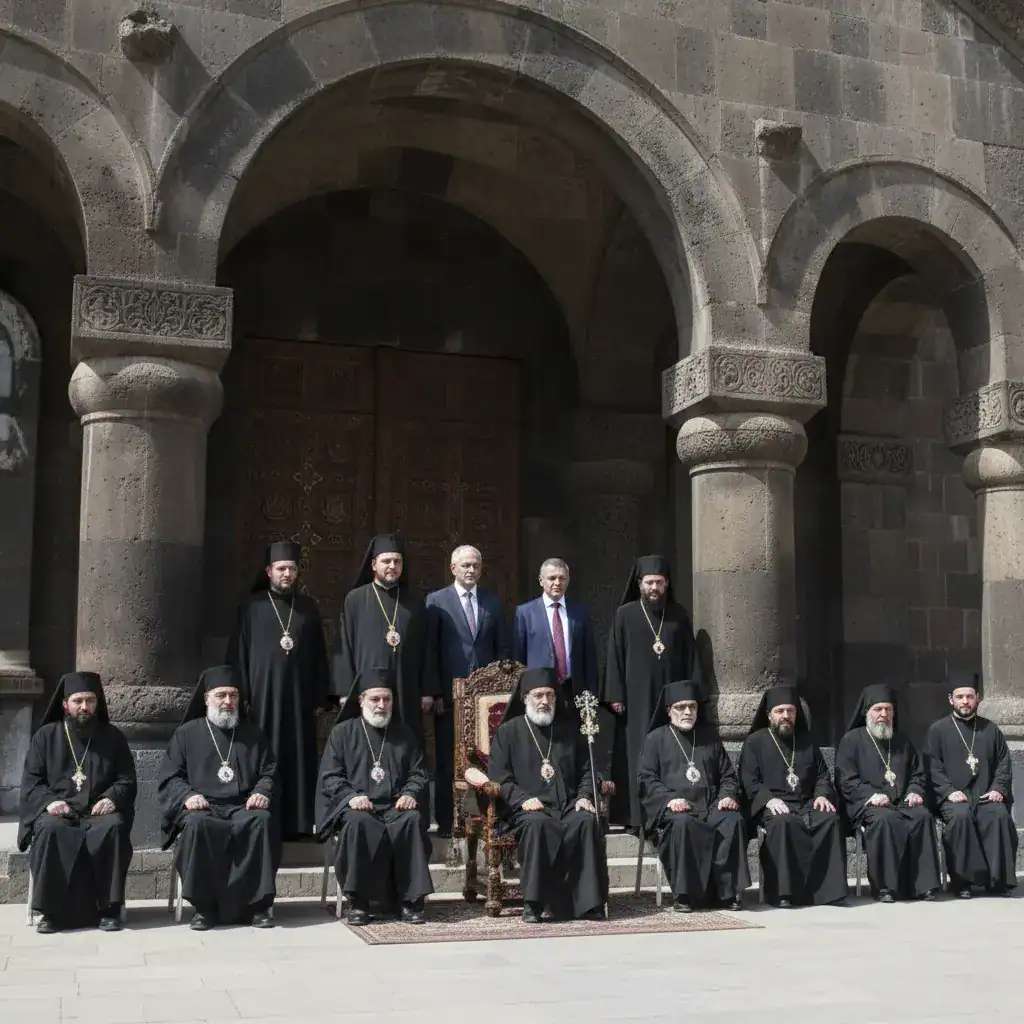
Supreme Spiritual Council Rejects Armenian PM’s European Parliament Accusations
Yerevan, March 13 – The Supreme Spiritual Council (SSC) of the Armenian Apostolic Church, under the presidency of His Holiness Karekin II, Supreme Patriarch and Catholicos of All Armenians, convened at the Mother See of Holy Etchmiadzin from March 10-13. During the meeting, the Council addressed various issues, including legislative initiatives concerning church-state relations and ongoing criminal, administrative, and civil cases against the Mother See of Holy Etchmiadzin and illegally detained or restricted clergymen.
Reports on these matters, including judicial acts and statistics, were presented by Mr. Gevorg Danielyan, PhD in Law, and attorney Mr. Ara Zohrabyan, PhD in Law. The SSC emphasized the imperative of respecting and upholding the rights and autonomy of the Church, justice, and democratic principles.
Condemnation of Government Actions
The Council unequivocally condemned the arbitrary and discriminatory actions of the Armenian authorities, the persecutions against the Armenian Church and its clergy, and the detentions based on fabricated charges. They also denounced attempts to artificially impede and restrict the Church’s activities through state mechanisms and illegal interference in ecclesiastical life.
Discussions also touched upon recent legislative bills and by-laws introduced by the authorities, which restrict the legal status and activities of the Armenian Apostolic Holy Church. The Council viewed the promotion of these measures as a convenient pretext for propagating anti-church narratives and their unhindered dissemination.
It was noted that such initiatives undermine the constitutional foundations of church-state relations, particularly the right to freedom of conscience and religion.
Rejection of Prime Minister Pashinyan’s Statements
The SSC specifically rejected the accusatory and fabricated statements made by Prime Minister Nikol Pashinyan against the Armenian Church and its clergy during his speech at the European Parliament on March 11, 2026. These accusations included terms such as “foreign influence agent” and “war party.” The Council stated that these remarks are an evident attempt to create grounds for justifying the illegal actions already carried out by the Armenian authorities against the Church and for future planned repressions.
During his March 11 speech at the European Parliament, Pashinyan stated that he would not have addressed the involvement of some clergymen in the peace process if he had not witnessed how the envoys of these clergymen and representatives of certain lobbying organizations associated with them were trying to spread narratives in the European Parliament and other reputable international bodies that the Armenian government is restricting freedom of conscience, that a dictatorship is being established in Armenia, and that there are political prisoners in Armenia.
“The reality is that some clergymen, who have cynically violated all rules of spiritual integrity, thereby making themselves vulnerable to foreign special services (by the way, the fact that some of them were KGB agents of the USSR is proven by documents), these clergymen have taken the leadership of the war party in the Republic of Armenia, gathering around them former leaders of Armenia, some forces associated with them, some Russian-based and pro-Belarusian oligarchs, and are trying to sacrifice Armenia’s independence to the interests of third countries,” Pashinyan had said.
The Supreme Spiritual Council’s strong condemnation underscores the growing tension between the Armenian state and its national church, a relationship that has historically been a cornerstone of Armenian identity and statehood. The Council’s statement highlights concerns over the erosion of religious freedoms and the autonomy of the church amidst political rhetoric.
The developments are being closely watched by both local and international observers, given the significant role of the Armenian Apostolic Church in the country’s social and political landscape. The Council’s call for adherence to democratic principles and constitutional norms suggests a deepening divide that could have lasting implications for the nation.