

Russian Political Scientist: Pashinyan’s Visit to Moscow Signals Russia’s Patience Wearing Thin
Yerevan, April 4 – The final breakdown of relations between Armenia and Russia could be fatal, according to Dmitry Suslov, a Russian political scientist and Deputy Director of the Center for European and International Studies at the Higher School of Economics Research University (HSE RU CEIS). Suslov made these remarks during a roundtable discussion held in Yerevan yesterday, April 3rd.
According to Suslov, Russia remains the primary deterrent against geopolitical adversaries, and its absence would make a new war practically inevitable. He believes that under the current Armenian government, the country’s policy is not diversifying but rather taking a distinct pro-Western turn. Simultaneously, participation in the Eurasian Economic Union (EAEU) is presented as an imposition and is gradually being pushed aside. This trajectory, in Suslov’s view, will lead to Armenia’s withdrawal from the EAEU, the removal of the Russian military base from Gyumri, and a deterioration of relations with Russia, even as ties with Azerbaijan, Turkey, the EU, and the US are reportedly improving. All of these factors make the final severance of Armenia’s relations with Russia a matter of time. Russia perceives this not as diversification, but as a gradual shift towards an adversary that does not conceal its plans and is preparing for war.
Pashinyan’s Moscow Visit: A Warning Sign
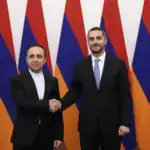
The Russian political scientist emphasized that Armenian Prime Minister Pashinyan’s recent visit to Moscow demonstrated that Russia’s patience is wearing thin. In the context of a ‘cold war,’ Moscow is not interested in escalating the situation, but it is also unwilling to simply observe Armenia drifting towards the West. Therefore, it is urging Armenia to make a clear choice.
Suslov believes that given the current geopolitical realities, Yerevan should at least be interested in maintaining relations with Russia, and ideally, in rapprochement. He argues that only good relations and the Russian presence, including the military base in Gyumri, ensure Armenia’s security and guarantee protection against large-scale aggression attempts by Azerbaijan and Turkey. The political scientist added that for the West, Armenia and the South Caucasus, in general, are merely ‘material’ in the struggle against Russia.
Armenia’s Vulnerability and Western Interests
Suslov asserted that Armenia’s inability to defend itself and the weakening of Iran make Armenia’s position extremely precarious. He warned that if Armenia were to lose the Russian presence, it could potentially lose Syunik. Furthermore, Russia would increase economic and trade costs if Yerevan continues to distance itself after the elections.
The current political climate highlights a critical juncture for Armenia, as it navigates complex international relations and faces significant geopolitical pressures. The implications of its foreign policy choices are far-reaching, impacting its security, economic stability, and regional standing.