


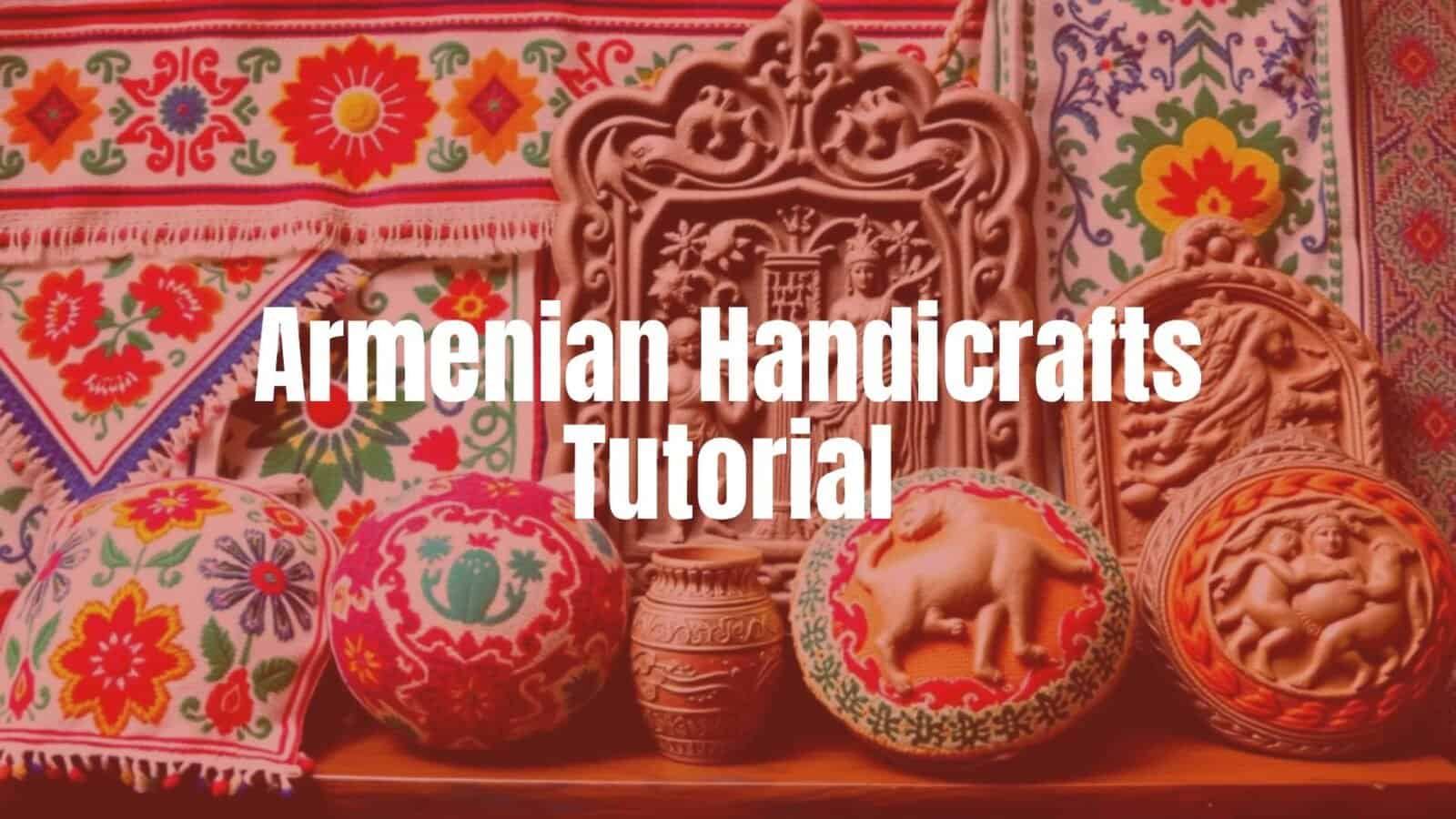
Starting an Armenian handicrafts tutorial means stepping into a colorful, living tradition where old customs are stitched, carved, and shaped into every object. These crafts are not just pretty items; they are living pieces of history, passed from one generation to the next, each one telling stories of strength, faith, and creativity. From the fine lines of embroidery to the solid shapes of khachkars, learning Armenian handicrafts lets you make beautiful things while also connecting with centuries of culture and art.
What Are Armenian Handicrafts?
Armenian handicrafts include many kinds of handmade art, all reflecting the country’s long history and close ties to its land. These crafts are more than decorations; they are physical links to a past where every item had a use and a meaning. Delicate needlework on clothing, large stone carvings in fields and churchyards, wooden instruments, and clay pots all show the wide range of Armenian skills, materials, and ideas developed over hundreds of years.
The main character of Armenian handicrafts is the mix of usefulness and beauty. Designs often come from nature, religion, and everyday life. The result is objects that look good and carry deep meaning, keeping stories and beliefs alive. Careful attention to detail and respect for old methods are key features of these crafts, helping Armenian art stay strong and recognizable over time.

Cultural Significance of Armenian Handicrafts
Armenian handicrafts are a strong part of Armenian identity, memory, and faith. For centuries, Armenian women have played a major role in keeping embroidery and needlework alive, teaching both the skills and the songs that go with them to their children. This way of learning by doing and listening helps each new generation understand the meaning behind every pattern and stitch. Armenian embroidery often becomes a symbol for lives and stories woven together, keeping culture and personal memories even when people are far from their homeland.
Outside of textiles, crafts like khachkar carving show the deep spiritual side of Armenian art. Khachkars are stone crosses carved with detailed designs, used as memorials and symbols of Christian belief. Armenia has more than 50,000 khachkars, all sharing a central cross but each with its own pattern. These stones act like prayers in stone, carrying messages of faith and remembrance. Traditional doll making, taught by artists like Susanna Mkrtchyan, also shows how crafts served ritual roles: dolls protected families, told fortunes, and acted as go-betweens. Made from many materials, they often became family treasures passed from women to girls.
Traditional Materials and Tools Used
The materials and tools in Armenian handicrafts reflect what was available in the Armenian highlands. In embroidery, people have long used silk, cotton, and sometimes gold thread on fabrics like silk, linen, and cotton. Natural dyes give the work strong colors, such as the bright red from the cochineal insect (vordan karmir), especially famous in carpets.
Woodworkers use local woods like walnut, cherry, and apricot to make furniture, religious pieces, and musical instruments such as the duduk. These woods are chosen for strength, easy carving, and attractive color and grain. Khachkar carvers use large slabs of tuff or basalt stone, shaping them with chisels and sand-blasting to bring out fine details. Potters work with the rich clay found throughout Armenia, forming it into wine jars called karas, dishes, and other household items using simple hand tools and kilns.
Types of Armenian Handicrafts to Learn
Armenian handicrafts cover many different skills, offering plenty of options for beginners. Each craft has its own methods and history, from the light touch of needlework to the heavy tools of stone carving. Whatever your interests, you can find a craft that suits your hands and imagination.
Learning these crafts is about more than gaining technical skill. It helps keep old traditions alive. Many techniques have been handed down through families and communities, changing slowly but still keeping their main style. By learning them, you become part of this ongoing story.
Armenian Embroidery Techniques
Armenian embroidery is one of the most important art forms in Armenian culture, showing centuries of careful needlework and storytelling with thread. It has been widely practiced since ancient times and reached a high point in the Middle Ages. Embroidery expresses religious ideas, artistic taste, and an endless variety of patterns and stitch types. Traditionally, there are two main groups: everyday embroidery for clothing and household items, and church embroidery for liturgical garments.
Armenian embroidery uses many kinds of stitches, from very simple to very complex. The names of these stitches often come from local dialects, tying them to specific regions. Plant designs are especially common, both stylized and natural. Geometric shapes, animals, birds, and even images of buildings and household objects also appear often. Each piece becomes a small picture story, rich with meaning and detail.
Armenian Needle Lace (Oya)
Although the term “Oya” is more widely used in the region, Armenian needle lace follows the same basic idea: lace made only with needle and thread, with no woven fabric base. In this craft, lace makers build patterns out of tiny knots and loops, sometimes forming three-dimensional shapes like flowers and leaves that later join larger designs.
The city of Van was especially famous for its fine lace. Lace from Van kept very old designs linked to the universe, plants, animals, and geometry. These patterns show a long tradition of careful and skilled work. Learning Armenian needle lace means practicing different knots and rows to build delicate shapes. It takes patience and a steady hand but rewards you with light, airy pieces that carry history and symbolism.
Woodcarving and Decorative Arts
Armenian woodworking is known for its rich detail and careful craftsmanship. Using walnut, cherry, apricot, and other local woods, artisans create both useful and decorative items. Their designs often borrow from Armenian architecture and nature, turning simple boards and blocks into detailed furniture, church fittings, and home objects.
Woodcarvers in Armenia also make fine musical instruments. The duduk, a very old double-reed instrument going back thousands of years, is carved from apricot wood. Its deep, emotional sound is central to Armenian music and appears in many film soundtracks around the world. Making such instruments calls for skill in carving and a good ear for sound, showing how Armenian woodwork brings together art, craft, and music.
Pottery and Ceramics
Pottery has been part of Armenian life for thousands of years, supported by the rich clay of the highlands. From at least the 3rd century CE, Armenian potters have formed clay into many shapes, from the large karas jars used for wine fermentation to plates, bowls, and special items like salt pots. Salt pots often have the rounded form of a pregnant woman, symbolizing the strong link between salt and life in Armenian belief.
Broken pieces of old Armenian pottery, decorated with detailed lines and symbols, can be seen in museums today, showing how long and steady this craft has been. Modern ceramic artists continue the tradition, mixing old ideas with new designs. Many workshops in Armenia let visitors try every step: shaping clay by hand or on a wheel, then drying, firing, painting, and glazing their own pieces.
Stone and Khachkar Carving
Stone carving, especially making khachkars, is one of the most powerful forms of Armenian art and faith. Khachkars (“cross-stones”) are tall, flat stones carved with a central cross and many surrounding patterns. They serve as memorials and as visible signs of Christianity. Armenia has more than 50,000 khachkars, each with its own design, even though the basic layout is similar.

Khachkar carving is passed down from master to apprentice. While students learn the classic methods, each carver also adds something personal or regional. The work is demanding: choosing a slab of tuff or basalt, drawing out the pattern, then slowly cutting away stone with chisels and using sand-blasting to sharpen the details. In 2010, UNESCO added Armenian khachkar art to its list of Intangible Cultural Heritage of Humanity. Many studios and cultural centers in Armenia offer short classes where visitors can try simple stone carving inspired by khachkar designs.
Armenian Rug Weaving
Armenian rug weaving has a long and famous past and is closely linked to Armenian identity. Traditionally, women did most of the weaving, teaching their skills and patterns to daughters and granddaughters. Armenian carpets are known worldwide for their complex designs, bright colors, and careful workmanship.
The patterns often mix general Armenian symbols with local touches, using geometric shapes and flowers. Some rugs even include words or short messages woven directly into the fabric. Many carpets show strong reds made with natural dyes like cochineal vordan karmir. Today, weavers still use old methods, and many groups work to protect and share this craft. In Yerevan, the Megerian Carpet Museum shows both old and new carpets, and markets like Vernissage offer many handmade rugs for sale.
Distinctive Styles in Armenian Handicrafts
Armenian handicrafts show strong regional character. Different areas have their own favorite motifs, colors, and stitch types, especially in embroidery. Knowing about these local styles helps you see the full variety of Armenian art and how different places shaped their own look over time.
Many embroidery styles take their names from the cities or regions where they grew. From Ourfa’s flat flower designs to the “woven” look of Marash stitching, each area shows its own taste and ideas. Studying these styles is like traveling across Armenia’s map through thread and pattern.
Ourfa Embroidery Threads and Style
Ourfa embroidery is easy to recognize by its flat, smooth look. It mostly uses colored silk thread, sometimes with touches of gold thread that catch the light. The work is done on fine silk or cotton cloth, which lets the even stitches show clearly. Ourfa patterns focus only on flowers-stylized blossoms or more natural shapes-arranged in balanced and careful layouts.
Women and girls in the Ourfa region used these embroidery and lace methods to make tablecloths, blankets, handkerchiefs, curtains, and pieces of traditional clothing. Ourfa embroidery was also an important part of a young woman’s dowry, proving her skill and her family’s care and status. Some of the best examples were given to churches as offerings, showing the respect and meaning attached to this work.
Sebastia Embroidery Techniques
Sebastia embroidery, named for its region, holds an important place in Armenian traditions and has been passed along for many generations. It is known for patterns that combine geometric shapes, fine floral motifs, and detailed borders. These designs do more than decorate; they often carry cultural and symbolic meanings.
The most famous stitch from this area is the Sebastia-Swazi, or Tars (backward) stitch. In this method, the embroiderer shapes the design from the underside of the cloth, pulling colored threads so that the pattern appears on the top. This creates a special texture and look. People used silk, wool, and metallic threads on silk, linen, and cotton fabrics. The type of thread, color, and cloth often depended on how the finished item would be used and who would own it, adding social meaning to the artistic choices.
Marash Stitch Patterns
The Marash stitch is a special and somewhat puzzling technique sometimes called the “woven” stitch. It stands out because the thread follows a very strict path. Even simple designs require the needle to move in a set order. The working thread passes along the same line four times. Only the first and second rows fasten to the cloth; the third and fourth rows are woven over the first two, creating a raised, strong line.
Marash embroidery usually uses twisted thin cotton threads on cotton or velvet cloth, which can support the dense stitches. The designs combine geometric forms, flower shapes, and meaningful symbols. Historically, silk, cotton, and metallic threads were all used, with fabrics like linen and silk as bases. The colors are often bold: bright reds, dark blues, rich greens, and gold, giving Marash pieces a striking and rich appearance.
Van and Ayntap Regional Designs
Van and Ayntap each add their own style to Armenian embroidery. Van’s embroidery is one of the oldest Armenian types and influenced work in areas such as Cilicia, Cappadocia, Tayk, and Constantinople. Van was especially known for fine lace. Lace from Van preserved very old images of stars and skies, plants and animals, and neat geometric patterns, showing a strong link to nature and the larger universe.
Ayntap is known as the “most delicate embroidery school.” Its special stitch technique starts by pulling threads out of the base cloth both across and lengthwise, leaving small open grids. These open spaces are then filled with decorative stitches, including shapes called “dumbbell and linear platformers,” producing a light, lace-like effect. Ayntap embroidery often uses sharp geometric figures-diamonds, squares, triangles-combined into complex, perfectly balanced layouts. Together, Van’s ancient lace and Ayntap’s fine openwork show the wide range and high level of Armenian embroidery.
Step-by-Step Armenian Handicrafts Tutorial
If you’re ready to work with your hands and learn Armenian handicrafts, this section will help you get started. You will not master every skill right away, but these first steps will introduce you to the main tools and simple methods behind several crafts.
Try to enjoy the process rather than rushing to finish. Work slowly, give yourself time to repeat and correct, and notice how each stitch, cut, or shape connects you to a long line of makers before you.
What Tools and Materials Do You Need?
Before you start any craft, gather basic tools and supplies. For Armenian embroidery you will need:
- Fine needles in several sizes
- Embroidery hoop to keep fabric tight
- Silk or cotton threads in different colors
- Linen or cotton fabric
- Pencil or water-soluble marker to draw patterns
For needle lace, you need a very fine needle and thin but strong thread, as all the work is done with thread alone. For woodcarving, start with:
- Basic carving knives or chisels
- A block or panel of wood (walnut, cherry, apricot, or an easier soft wood to practice)
- Sandpaper for smoothing
- Wood oil or wax for finishing
For pottery, collect:
- Clay suited to hand-building
- Sponges and water container
- Wire cutter
- Simple modeling tools or wooden sticks
- Access to a kiln (through a class or studio)
A potter’s wheel is helpful but not required for beginners. For a first step into stone carving, instead of a large khachkar, start with a small soft stone like soapstone and simple carving tools. Always think about safety: keep tools sharp and clean, work in good light, and protect your hands and eyes where needed.
How to Start with Armenian Embroidery
To begin with Armenian embroidery, choose a simple pattern with clear lines. Many starter designs use flowers, geometric forms, or birds. You can copy old Armenian motifs from books, museum photos, or beginner pattern sheets.
Transfer the design to a piece of plain linen or cotton with a light pencil or washable marker. Place the fabric in an embroidery hoop and tighten it so there are no wrinkles. Pick a color set you like. You might choose reds, blues, and greens that echo traditional natural dyes.
Start with one or two basic stitches, such as running stitch or backstitch, to get used to holding the needle and controlling tension. Once you feel more confident, you can slowly add more complex Armenian stitches and fill in areas, outlines, and borders. Over time your work will move from simple lines to rich, layered patterns. Regular practice is more helpful than long, rare sessions.

Learning Popular Armenian Embroidery Stitches
To truly get into Armenian embroidery, spend time learning the main regional stitches:
- Ourfa stitch: Flat, smooth embroidery, usually in silk on silk or cotton, for flower patterns. Focus on even tension so the surface stays flat.
- Sebastia-Swazi (Tars or backward stitch): The needle works mainly from the underside, pulling thread up to form the design on top. This gives the work a special structure and feel.
- Marash stitch: A “woven” style where the thread passes four times along the same path. The first two rows attach to the cloth; the next two are woven on top, forming a raised, strong line.
- Ayntap stitch: An openwork technique, where you remove threads to make small grids and then embroider into the empty spaces with geometric patterns.
Practice each stitch on scrap fabric first. Try simple lines, borders, and small motifs before joining them into a full design. This will give you a feel for how long each stitch takes and what kind of patterns it suits best.
Making Armenian Needle Lace: A Beginner’s Guide
Armenian needle lace (Oya) looks complex but can be learned step by step. You will need a fine needle and strong, thin thread such as mercerized cotton or silk.
- Learn the basic knot, often called the buttonhole or blanket stitch. Make rows of these knots on a base thread or along the edge of a piece of fabric.
- Practice making small loops (picots) by changing the height and spacing of your knots.
- Use these loops to build simple shapes like small rings or petals.
- Combine rings and rows into simple flowers or leaf forms.
Books, online diagrams, and videos showing Armenian lace patterns are helpful. Work slowly and keep your hands relaxed. Because the lace is very fine, it is better to do short, focused sessions instead of long, tiring ones.
Basic Patterns for Wood Carving and Pottery
For Armenian-inspired wood carving, start with easy outline designs. Draw basic shapes-squares, circles, triangles-on a flat wood panel. Then try simple motifs found often in Armenian art:
- Grapevines and leaves
- Pomegranates
- Crosses with straight or slightly curved arms
Use shallow cuts at first, aiming for clean lines and steady depth. As you gain control, you can add layers, background lowering, and small details.
For pottery, begin with hand-building:
- Pinch pots: Roll a ball of clay and press your thumb into the center, gently pinching the walls into a small bowl.
- Coil pots: Roll long “snakes” of clay and stack them to form the walls of a jar, smoothing inside and outside.
Decorate your pieces with lines, dots, and simple symbols scratched into the damp clay. Look at photos of old Armenian ceramics for ideas such as spirals, wavy lines, and repeated geometric patterns. After drying and first firing (bisque), you can paint with glazes in earthy tones, reds, and blues before a final firing.
Tips for Beginners in Armenian Handicrafts
Starting Armenian handicrafts can feel both exciting and a bit challenging. A few simple habits will help you move forward and keep your interest strong.
Give yourself time, repeat often, and accept that mistakes are part of learning. Each error teaches you something about the material, tools, or technique. All skilled artisans began where you are now.
How to Avoid Common Mistakes
When you begin, some problems are very common, but you can reduce them with a few simple rules:
- Do not hurry. Crafts like embroidery, lace, and carving need a steady pace. Rushing causes uneven stitches, broken threads, and messy cuts.
- Start small. Do not pick the most complex rug pattern or a full-size khachkar as a first project. Choose small designs and simple shapes.
- Practice on scraps. For embroidery, use leftover fabric to learn stitches before moving to your main piece. For wood and clay, begin with test blocks and small pots.
- Use suitable materials. Thick thread on fine fabric, very hard wood for a beginner, or clay meant for other firing temperatures can all cause problems. Ask a teacher, shop owner, or online group which materials fit your project.
- Allow corrections. Unpick stitches, re-wet and reshape clay, or sand back a carving if needed. Fixing mistakes is normal and helps you improve.
Where Can You Find Patterns and Resources?
There are many helpful sources for Armenian patterns and learning material:
- Museums and cultural centers: Collections of Armenian textiles, carpets, pottery, and stonework give real examples to study. The Megerian Carpet Museum in Yerevan is a strong resource for rug motifs and colors.
- Books: Look for books on Armenian folk art, embroidery, carpets, or ceramics. Many include pattern charts and historical background.
- Websites and online archives: Some museums and cultural groups post photos and digitized collections online. These often show traditional garments, church items, and home textiles with clear close-ups.
- Workshops and classes: Centers like the Gyumri Aesthetics Center, created by Professor Susanna Mkrtchyan, teach embroidery, rug weaving, doll making, and more. Such classes usually give you access to patterns, tools, and personal guidance.
- Online communities: Social media groups and craft forums focused on Armenian art share patterns, tips, and answers to questions. You can post photos of your work and get feedback from more experienced makers.
Frequently Asked Questions about Armenian Handicrafts Tutorials
People starting Armenian handicrafts often share similar questions. The answers below cover some of the most common topics and can help you plan how and where to learn.
Can You Learn Armenian Handicrafts Online?
Yes, you can. While learning from a master in person is very valuable, online options make Armenian crafts open to people everywhere. Many artists and cultural groups share video lessons, step-by-step guides, and pattern files for embroidery, weaving, doll making, wood carving, and pottery.
YouTube has many videos showing specific stitches or projects. Some schools, such as TUMO Studios, offer structured online courses that include Armenian embroidery and other crafts. There are also online communities where you can ask questions, show your progress, and learn from others’ experience. With patience and practice space at home, online learning can take you a long way.
Should You Use Traditional or Modern Materials?
Your choice of materials depends on what you want from the craft and what you can find or afford. Traditional materials-like silk or wool threads dyed with natural colors, apricot wood for instruments, or local clays-give results close to old Armenian pieces. They also help you feel more connected to how past artisans worked. Natural silk shines in a special way, and naturally dyed wool has slight color changes that give depth to carpets and embroidery.
Modern materials can still be very useful, especially at the beginning. Synthetic threads are cheaper, easy to find, and come in a wide color range. Soft practice woods and common clays are kinder to new hands and tools. Many learners start with these to focus on technique without worrying about wasting expensive supplies.
You might begin with modern options while you are learning, then slowly move to traditional ones as your skills and confidence grow. What matters most is careful, honest work and respect for the Armenian traditions you are practicing, whatever materials you choose.











Leave a comment