
Armenia and France Forge Strategic Partnership
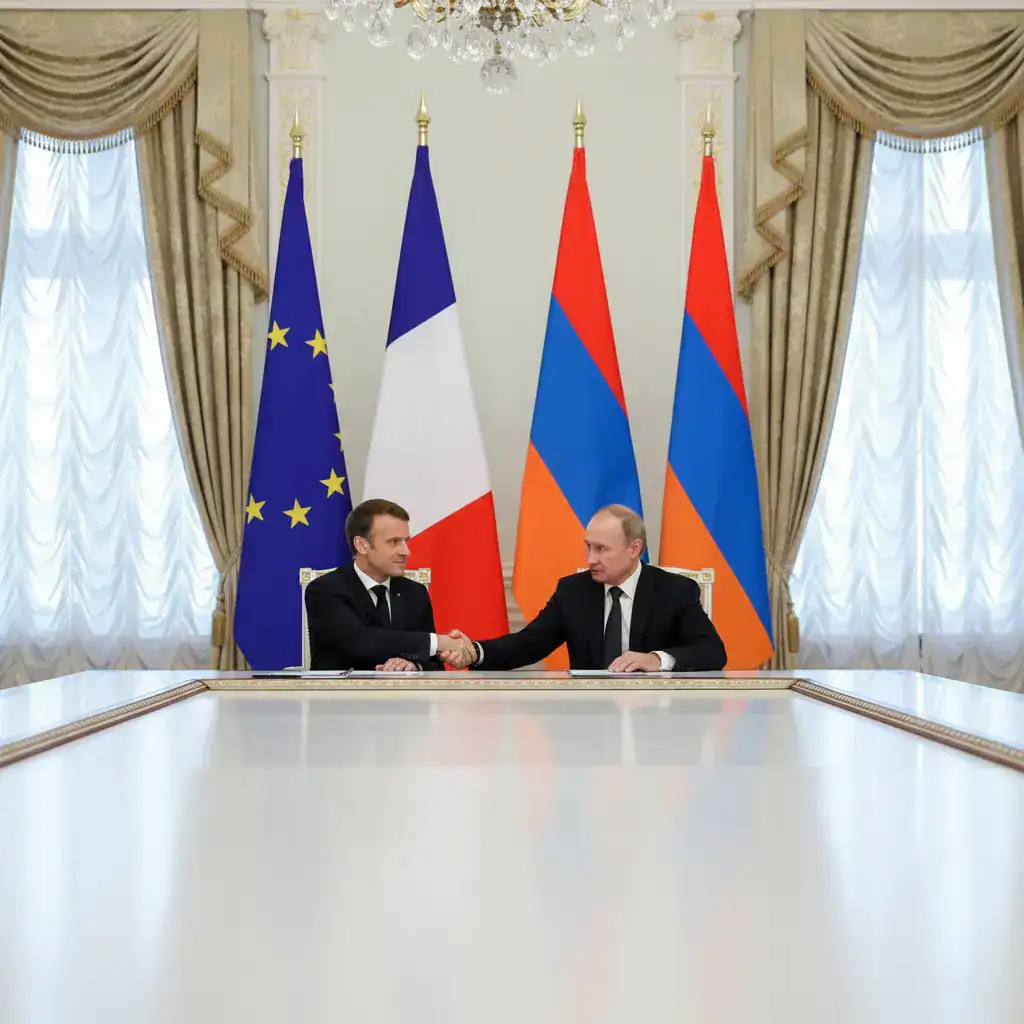
Yerevan, Armenia, May 6, 2026 – The Republic of Armenia and the French Republic have officially elevated their bilateral relationship to a strategic partnership, as confirmed by a joint declaration published by the Armenian government on Tuesday, May 5, 2026. This comprehensive agreement underscores a shared commitment to deepen and expand cooperation across a multitude of sectors, reflecting strong historical ties, common democratic values, and mutual national interests.
The declaration, signed in Washington on August 8, 2025, and further elaborated through a declaration of intent between the foreign ministers on May 26, 2025, outlines a robust framework for collaboration in political, economic, justice, defense, security, cultural, humanitarian, educational, university, scientific, social, environmental, technological, and decentralized cooperation fields.
Foundations of the Partnership
Both nations reaffirmed their adherence to international law, particularly the principles enshrined in the United Nations Charter and the Helsinki Final Act. They also expressed a desire to contribute to regional and international security, stability, and peace. A key aspect of the partnership is the commitment to strengthening lasting peace in the South Caucasus, respecting the sovereignty and territorial integrity of states, and adhering to the principles of the UN Charter and the 1991 Alma-Ata Declaration.
Armenia’s commitment to deepening its political, economic, security, and social relations with the European Union, as outlined in the Armenian law on initiating the process of Armenia’s accession to the European Union, was also highlighted.
Key Pillars of Cooperation
1. Political Dialogue, Bilateral and Multilateral Cooperation
The governments of Armenia and France will continue and deepen political dialogue at all levels, with foreign ministries holding regular consultations at least once a year. These consultations will assess progress and define future actions for expanding the strategic partnership. Discussions will also focus on deepening Armenia’s relations with the European Union, based on the Comprehensive and Enhanced Partnership Agreement and the new strategic agenda for Armenia-EU partnership. This aims to support Armenia’s rapprochement with the EU, strengthen its sovereignty and resilience, reinforce democratic institutions, protect human rights, facilitate trade, and encourage European investment in Armenia.
Both countries reiterated their commitment to open and rules-based multilateralism, continuing active cooperation within the UN, International Organization of La Francophonie, Council of Europe, OSCE, and other international forums like the European Political Community. They will also foster close cooperation in human rights, rule of law, good governance, and anti-corruption efforts.
Gender equality and the protection of women’s and girls’ rights are also central, with a commitment to combat all forms of inequality and violence. Armenia will take steps to ratify the Council of Europe Convention on Preventing and Combating Violence Against Women and Domestic Violence.
2. Security and Defense
Armenia and France will develop their partnership in security, defense, military education, military-technical, and military-technological fields on a long-term basis, including industrial cooperation to strengthen their defense capabilities. High-level dialogue will continue at the General Staff level, with regular consultations between relevant ministries. Cooperation will also deepen within international organizations on international and regional security, arms control, and non-proliferation.
Both nations intend to strengthen cooperation in international peacekeeping missions, with France’s support for expanding Armenia’s participation, including within the EU’s Common Security and Defense Policy.
Defense Industry Cooperation
Cooperation in the defense industry will be developed, potentially leading to specific agreements between Armenian and French companies. Regular consultations will be held between Armenia’s Ministry of High-Tech Industry and France’s Ministry of Armed Forces and Veterans’ Innovation Agency to advance defense research, development, and innovation.
Cooperation in AI, Cyber, and Digitalization
Bilateral cooperation in cybersecurity will be enhanced through exchanges between competent authorities and partnerships with the private sector. Efforts to combat cybercrime will be strengthened through technical assistance and capacity building for law enforcement and investigative services. Cooperation in artificial intelligence and data science will also be reinforced. Both countries will collaborate on programs to increase the digital maturity of companies, improve digital skills, strengthen technological capabilities, and promote the use of AI solutions.
Combating Information Manipulation
To ensure information integrity, access to free and reliable information, and freedom of expression, Armenia and France will strengthen cooperation against external information manipulation. This includes sharing experiences in public diplomacy and related fields, particularly within the framework of the ‘Partnership for Information and Democracy’ and initiatives supported by France.
Internal Security
Cooperation in internal security will be strengthened through technical and institutional assistance and operational capacity building. Both countries will continue efforts to combat terrorism and organized crime, including illicit drug trafficking (especially through the European Alliance Against Drugs launched within the European Political Community), human trafficking, and irregular migration.
Disaster Risk Management
Cooperation in natural and technological disaster risk management will focus on risk reduction and rapid, targeted emergency response. This involves expanding collaboration between civil defense and crisis management services, both bilaterally and multilaterally. Measures will be taken to strengthen volunteer rescue teams, provide first aid training to the public, and improve early warning systems, potentially with support from the French Red Cross for the Armenian Red Cross.
Migration
A comprehensive approach to migration will involve developing and implementing joint programs. Measures will be taken to prevent and combat irregular migration, particularly in the context of medical residency, and facilitate returns in accordance with the 2013 agreement between Armenia and the EU on the readmission of persons residing without authorization. France will implement its assisted voluntary return and sustainable reintegration policy for Armenian citizens, respecting fundamental rights.
France welcomes the dialogue on visa liberalization between Armenia and the EU, which began in September 2024, and will cooperate closely on its implementation.
3. Economic Cooperation and Connectivity
Armenia and France will expand their economic and trade relations, building on efforts within the ‘Armenian-French Economic Cooperation Roadmap 2021-2026.’ This includes strengthening cooperation in infrastructure, sustainable transport, agriculture, food security, healthcare, innovation, digitalization, AI, semiconductors, aerospace, waste management, environment, natural resource valuation, and financial services.
Efforts will continue to promote inclusive connectivity projects benefiting the region’s people, such as Armenia’s ‘Crossroads of Peace’ initiative, the TRIP project, and EU initiatives like the ‘Global Gateway’ strategy. Cooperation in renewable energy and civil nuclear energy will be deepened, along with collaboration in critical minerals and metals.
Both countries will continue cooperation on water and irrigation to ensure sustainable resource management, supporting the French Development Agency and decentralized cooperation initiatives. They will also promote dialogue and cooperation between private and public stakeholders in these sectors.
Emphasis is placed on the free movement of goods and services, with efforts to encourage investments, develop bilateral trade, and strengthen intellectual property protection. They will respect and prevent circumvention of restrictive measures adopted by the European Union.
Effective communication between economic structures of both countries will be fostered, involving organizations like ‘Business France,’ ‘Enterprise Armenia,’ ‘MEDEF International,’ and chambers of commerce. The opening of French Development Agency and ‘Expertise France’ offices in Armenia is welcomed as a catalyst for large-scale economic projects.
4. Global Challenges
Cooperation will be strengthened to achieve Sustainable Development Goals, promote innovation, ensure ecological and energy transition to a green economy, and protect the environment and biodiversity. Both nations will closely collaborate in international forums on global challenges.
Armenia and France reaffirm their commitment to the goals of the 2015 Paris Agreement on climate change, working together to implement the global review decision adopted during COP28 to transition away from fossil fuels. Discussions will cover practical measures to achieve climate neutrality by 2050, in line with the Paris Agreement’s target of limiting global temperature rise to 1.5°C. Adaptation and mitigation programs will be implemented in the most affected sectors, mobilizing targeted funds and financial mechanisms, including a ‘debt-for-climate’ mechanism.
In biodiversity, both countries reaffirm their commitment to the Kunming-Montreal Global Biodiversity Framework and will deepen cooperation for the protection of terrestrial, coastal, and marine areas. France will support Armenia in preparing for and successfully hosting the seventeenth Conference of the Parties (COP17) to the Convention on Biological Diversity in Yerevan in 2026, and will support Armenia during its COP17 presidency.
Cooperation in healthcare will be strengthened to improve prevention capabilities, particularly through the ‘One Health’ approach, and enhance the resilience of healthcare systems to pandemics and global health crises. This includes collaboration on universal health insurance and digitalization of healthcare systems (including AI in healthcare). Training courses and exchange programs for healthcare professionals will be organized. Regular dialogue on global health issues will be established within international organizations.
5. Education, Science, Culture, Sports, and Youth
Cooperation between universities, schools, and vocational training institutions will be strengthened through exchange programs, trainings, and master classes, utilizing tools like Erasmus+. Academic cooperation will deepen, developing dual or joint degree programs, especially within the French University in Armenia.
Joint scientific research in areas of mutual interest will be conducted, along with researcher mobility programs and collaboration between French national research bodies and Armenia’s Ministry of Education, Science, Culture, and Sports’ Higher Education and Science Committee.
France welcomes Armenia’s ‘Academic City’ project, recognizing its potential as an ambitious initiative in science and higher education. Both countries will collaborate on developing the project to host the French University in Armenia within the Academic City and encourage the involvement of leading French universities.
Armenia and France will support the teaching of French in Armenia and Armenian in France, recognizing the importance of their membership in the International Organization of La Francophonie, the French University in Armenia, the French Institute in Armenia, and the Anatole France French International Educational Complex. They will also promote the translation and publication of Armenian literature in France and French literature in Armenia. Both countries acknowledge the contribution of media to the development of Francophonie, particularly ‘France24’ and ‘RFI,’ and will support their promotion. They may also facilitate the promotion and broadcasting of ‘TV5Monde’ and ‘TV5MondePlus.’
Cultural dialogue will be fostered bilaterally and within multilateral structures. Cooperation in cultural heritage preservation will be strengthened, especially within UNESCO and the International Alliance for the Protection of Heritage in Conflict Areas (ALIPH). Efforts will be made to promote cooperation between their national commissions for UNESCO.
Cooperation in museum, heritage, and archaeological fields will be enhanced through knowledge transfer in preservation and restoration, particularly through the National Institute of Heritage. Collaboration in artistic creation, cultural and creative industries, and exchange of ideas will be encouraged, fostering partnerships between Armenian and French cultural institutions and mutual presence at key cultural events.
Experience exchange and cooperation will be promoted between the Armenian Film Foundation, the French National Centre for Cinema and Animated Image, and the French Cinémathèque.
Contacts between young people will be fostered through joint programs, participation in volunteer activities, and development of school partnerships. Cooperation in sports will be strengthened through experience exchange in organizing major sporting events, particularly within the context of the 2027 Francophonie Games, and through training for sports movements, especially for high-level athletes, and on inclusion issues.
6. Decentralized Cooperation and Civil Society
Armenia and France recognize the role of territorial units and civil society organizations in deepening relations. They will promote decentralized cooperation and support civil society initiatives in economic, agricultural, tourism, cultural, educational, and healthcare sectors, while respecting the right of stakeholders to define cooperation terms.
Emphasis is placed on regular contacts, exchanges, and information sharing between direct actors of decentralized cooperation. Conferences on decentralized cooperation will be organized alternately in Armenia and France at least every three years.