
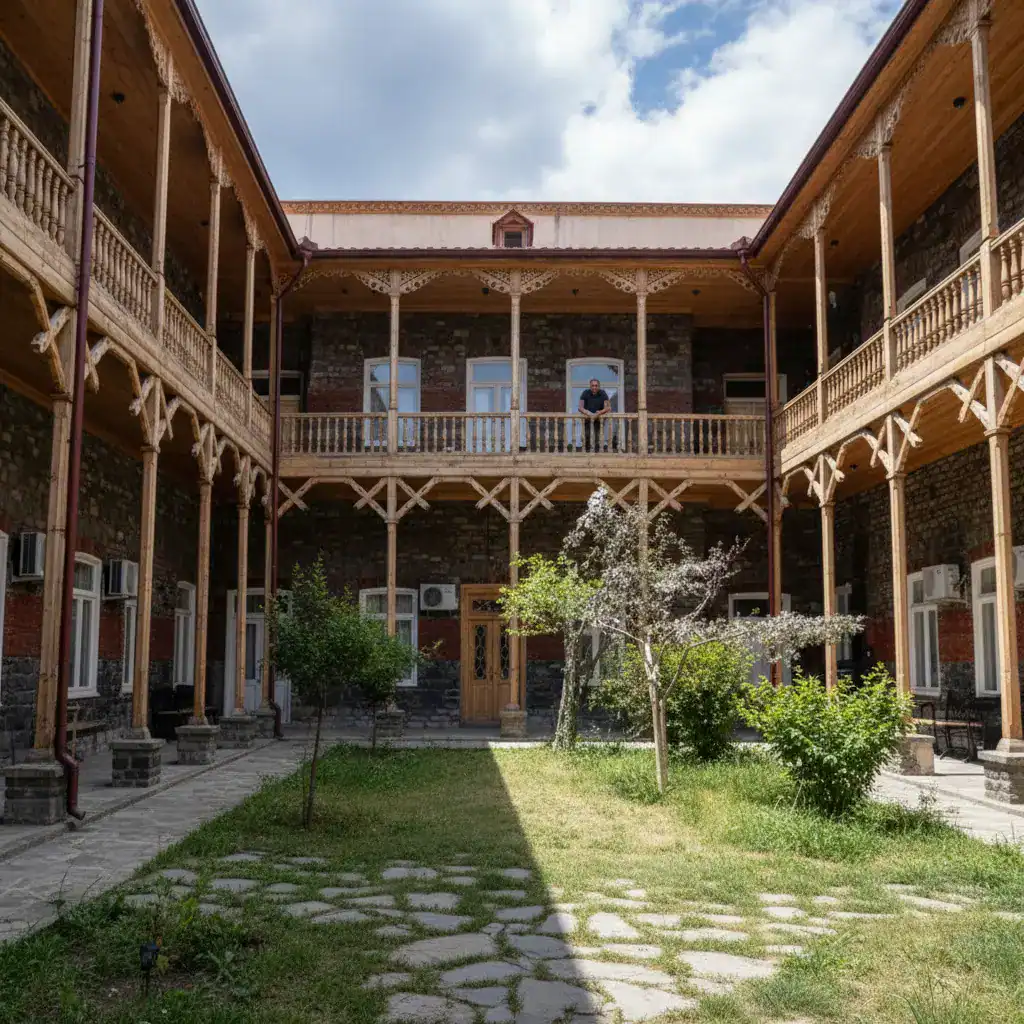
In the heart of Gyumri, within one of its most culturally significant and tourist-attracting buildings, the Mariam and Eranuhi Aslamazyan Sisters Gallery, a persistently unused attic space is undergoing a remarkable transformation. This forgotten corner is being reborn as a Community Art Lab, a vibrant hub designed to foster creative opportunities and cultural exchange.
From Unused Space to Creative Catalyst
The vision for this space is to create a dynamic creative center, a platform for cultural exchange, and a vital meeting point for the city’s artists. Upon completion, this previously neglected section of the gallery will evolve into a fully equipped creative infrastructure for Gyumri, breathing new life into its artistic landscape.
The Aslamazyan Sisters Gallery, situated within the ‘Kumayri Reserve-Museum’ area, has been operating since 1987, showcasing the sisters’ paintings, graphics, and ceramics. While already a significant cultural institution, this new project aims to expand its role, transforming it from a traditional museum into a lively platform for contemporary creation.
A New Creative Infrastructure for Gyumri
The future Art Lab will feature a workshop, a contemporary art exhibition hall, a multimedia library, an Anti-café, and technologically advanced laboratories. These facilities will cater to the specific needs of Gyumri, linking creative activities with urban development. For instance, if the city requires new designs for public infrastructure-such as billboards, benches, or waste bins-this space will provide creative individuals with the resources to produce them. The attic is envisioned as a central point that will shape and influence the city’s cultural aesthetic.
The project also includes direct access to the rooftop from the gallery’s courtyard. The courtyard itself will host a stage for concerts and other cultural events, cultivating a lively and creative atmosphere. All these elements are designed to transform the area into an active cultural zone.
An International Creative Hub
The project will host international artists through renowned artist-in-residence programs. Painters, musicians, writers, and other creative individuals will be invited to work in Gyumri, stepping out of their usual environments to live, work, and create in a new artistic setting. The Aslamazyan Sisters Gallery anticipates hosting 10-12 artists annually, who will work in the newly established art laboratory in the attic, with their works exhibited there. Master classes will also be organized in the space.
The initial planning phase of the project has already been completed, marking a significant step towards its realization.
The Genesis of an Idea
Karen Barseghyan, director of the Mariam and Eranuhi Aslamazyan Sisters Gallery, shared with Aravot.am that for a long time, they sought effective ways to utilize the large, unused attic. “Gyumri’s cultural life needs many spaces, and that brought our idea to life. We gathered with friends, discussed the concept, and since the EU program was underway, with the participation of Lilit Tovmasyan, head of the city hall’s culture department, it was refined and included in the program,” Barseghyan recounted.
The project, funded by the European Union, is part of the “Mayors for Economic Growth” (M4EG) initiative, launched in 2017 and implemented by the UN Development Program since 2021. This initiative works with communities to develop their internal capacities, enabling them to create local economic and cultural strategies through an innovative methodology called a portfolio approach.
Barseghyan explained: “We received funding for the first phase of concept development. To develop the concept, we gathered the community’s artists in our gallery, discussed the idea, and how to implement it. We developed the concept, then with the participation of several architects, the project was formed, approved, and the idea began to materialize.”
He added that after the project’s completion, the gallery will be able to collaborate with art laboratories in various European countries. It will also promote an increase in tourist flow; instead of visiting Gyumri’s cafes and working there with laptops or phones, tourists will be able to come to the gallery’s attic, where they will be provided with high-speed internet, allowing them to work before continuing their exploration of Gyumri.
M4EG Initiative’s Role in Gyumri’s Development
According to Krist Marukyan, head of the “Mayors for Economic Growth” initiative, the “interventions” carried out by the program in Gyumri have focused on cultural tourism and the development of existing cultural infrastructure.
In an interview with Aravot.am, Krist Marukyan stated: “With the portfolio team, we tried to understand whether the culture presented in Gyumri consists of cultural samples created a hundred years ago, and whether Gyumri continues to produce culture.”
The first beneficiary communities of the initiative in Armenia are Areni, Gyumri, and Kapan. The third phase of the initiative has begun and will run until 2028. In this phase, the initiative is working with the communities of Noyemberyan, Aparan, and Goris. Two more new communities are expected to join the program in the coming month.
Speaking about the initiative’s activities, Krist Marukyan noted that they begin with community listening, during which community administration employees listen to how residents see the community’s problems, solutions, and their role. By combining this information, they understand the community’s development vision. “Then the directions for interventions were decided. Kapan chose the direction of solving social problems and business diversification, Areni, as an enlarged community, focused on integrating the nine newly joined settlements into tourist offers through the discovery of local attractions. In Gyumri, the emphasis was placed on cultural tourism, as well as on the introduction of tools that will support the community in effective data collection, analysis, and decision-making processes in the field of tourism.”
Krist Marukyan reported that among the initiative’s “interventions” in Gyumri are the development of a new concept for transforming the third floor of the Aslamazyan Sisters House-Museum into an art laboratory and its presentation to the community administration, as well as the creation of an entirely new exhibition concept, including architectural designs, drawings, visual representations of the exhibition, and training for the staff of the Mher Mkrtchyan House-Museum. Three info points have also been installed in Friendship Park, in the area of a pottery company, and in the Aslamazyan Sisters House-Museum.
Krist Marukyan informed: “20 employees from various organizations, who can potentially provide info point services, have been trained. This also ensures the long-term operation and stability of these info points.”
Within the framework of the initiative, a blacksmithing training course was also developed in cooperation with 10 families engaged in traditional local blacksmithing, during which about 25 young people received professional training. Subsequently, the course was included in the curriculum of one of the local vocational education institutions.
The Gyumri tourist pocket map was also published within the framework of the initiative, and the visitgyumri.info website was created. The platform presents all service providers, allowing visitors to plan their trips in advance.
We asked what impact the initiative will have on the development of Gyumri in the long term, and Krist Marukyan replied: “The initiative helps the community formulate the vision of where the community should direct its development. This provides an opportunity to identify the so-called missing parts of the puzzle and consider new cooperation initiatives from that perspective. It also helps to direct investments attracted by other programs in a more targeted and effective way.”
Community Space, Cooperation, and Long-Term Impact
Lilit Tovmasyan, head of the culture and youth affairs department of the Gyumri community administration, noted in an interview with us that the goal of gathering free creative artists of the cultural city in one place served as an impetus for the implementation of this initiative. “We are going to create a space that will be equipped with technical equipment, computers, printing devices, where it will be possible to design, draw, implement ideas, and put them into production. This is also an excellent example of a museum and a community as an enterprise, because the basis of our idea, for example, is the following concept: students of the State Academy of Fine Arts work in that area and offer the community, conditionally, concepts for trash cans, benches, or street lighting, which they give to the community for free as a product of the art laboratory. We would not want to have a program that starts here today and ends tomorrow, but one that creative people, young people, and the community will be equally interested in maintaining, because the community clearly understands that this is a space for generating ideas, for which it will no longer spend money.”
Lilit Tovmasyan emphasized the idea of connecting free creative artists with the community and the Aslamazyan Sisters Gallery. All creative people will use this space for free; it will be a place for meetings and creative discussions, and the city will benefit from this.
She observed: “Very often artists know other artists in the city, but they don’t know what they are doing and what their capabilities are. This space can become a platform for exchanging experience for the younger generation if they also know that there is an open-access space in this field, they know that they will meet masters, older creative people, representatives of the older generation, with whom there will be an exchange of experience, ideas, and from this, cultural products will certainly be born. And finally, it will be interesting for tourists, creating both intercultural exchange and economic benefits for the community.”
According to Lilit Tovmasyan, the art laboratory will also serve to digitize the fund of the Aslamazyan Sisters Gallery. Technical means will also be used for the digitization of the fund sections of other museums. “Digital accessibility and preservation of cultural heritage are extremely important today. Although transporting works of art abroad can be costly, digital exhibitions require significantly fewer resources and allow cultural heritage to be much more widely spread.”
According to Lilit Tovmasyan, they expect to organize on-site printing and production with modern printing facilities, capable of printing materials that will be sold in the museum and generate additional income. The museum can also take orders.
According to Lilit Tovmasyan, within the framework of the program, monitoring, research, concept development, problem identification, and risk assessment were carried out. In the second phase, design work was done, and a documented and approved project exists.
All that remains is the renovation of the attic and its technical equipping. “One more push and what is unfinished will be brought to its final goal,” concluded Lilit Tovmasyan.
Since 2021, the EU-funded “Mayors for Economic Growth” program has been supporting communities in Armenia and Eastern Partnership countries in building more inclusive, sustainable, and human-centered communities. Through close cooperation with local authorities and residents, the program helps turn local ideas into practical solutions that improve community life and contribute to long-term development.
Source: https://euneighbourseast.eu/hy/news/stories/arvesti-laboratoria%D5%9D-datark-mnacac-jeghnaharkum-steghcarar-hnaravorutyunneri-kentron%D5%9D-gyumrium/