


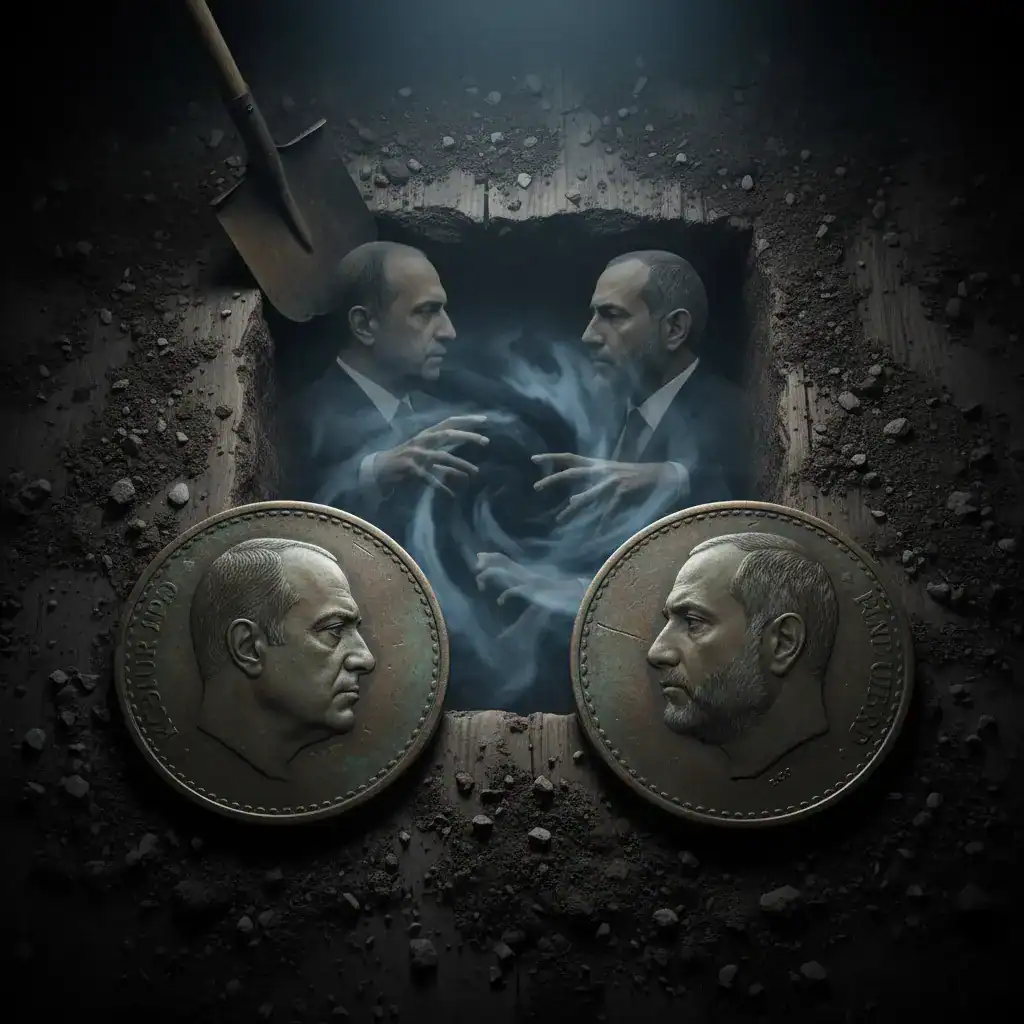
In a powerful and provocative commentary published yesterday, Mikael Minasyan, Armenia’s former ambassador and son-in-law of ex-President Serzh Sargsyan, delivered a searing indictment of both former President Robert Kocharyan and current Prime Minister Nikol Pashinyan. Minasyan contends that the two political figures, despite their historical antagonism, have evolved into strikingly similar entities, each contributing to the nation’s profound crisis.
The Uncanny Resemblance: A Shared Path to Destruction
Minasyan’s central thesis is that the resemblance between Kocharyan and Pashinyan is not accidental or superficial, but rather a profound mirroring forged through years of intense, yet ultimately unproductive, struggle. He posits that Pashinyan began to emulate Kocharyan in the 2000s during his politically futile opposition, while Kocharyan, in turn, started to resemble Pashinyan after 2019, engaging in an equally ineffective and stubborn fight against the current Prime Minister.
According to Minasyan, this prolonged confrontation has transformed them into the same political essence, albeit with different nuances. One is depicted as a pro-Turkish dictator who disregards the people despite coming to power on a wave of popular support. The other, a pro-Russian figure who disdains Armenia itself, having governed it for a decade.
Kocharyan: The State Without the People
Minasyan observes that Robert Kocharyan was always a statesman, yet herein lies the tragedy. He never truly understood the people or the true nature of power as a weighty responsibility rooted in public trust. Consequently, his years in power became a symbol of the worst perceptions of authority, the deepest fears, and the most abominable manifestations.
The state, in the eyes of the people, transformed not into a common home but into a closed resource for the chosen few, a secret repository of opportunities accessible only to insiders. The Armenian people became alienated and wounded by the state. Minasyan argues that the Armenian state itself was never as flawed as it was reflected and distorted through Kocharyan’s personality, conduct, and governing culture.
Pashinyan: The People Without the State
Conversely, Nikol Pashinyan, Minasyan claims, did not recognize the state. He emerged from the people, speaking their language and rhetoric. Yet, precisely for this reason, he became the embodiment of the people’s worst traits. Minasyan clarifies that the people themselves are not inherently bad, but Pashinyan personifies those characteristics that everyone knows, has seen, but chose to ignore or avoid confronting. He is the mirror in which society refuses to look, because it reflects not its virtues, but its disorder, malice, envy, accumulated hatred, and political immaturity.
A Fateful Encounter and a Continuing Tragedy
Their destinies fatally intertwined on March 1, 2008, when one instigated bloodshed and the other readily accepted the challenge. Since that day, their fates have been entangled. To this day, hating each other but also feeding off each other, drawing strength and justification from their rivalry, they continue to destroy the country and morally corrupt the people.
Minasyan highlights that Pashinyan now almost entirely replicates Kocharyan’s repressive logic of power, his governing methods, and his tools of suppression. Meanwhile, Kocharyan continues his struggle with the same political futility, stubbornness, and inability to comprehend public rejection that characterize Pashinyan. Minasyan emphasizes a simple truth: just as the people did not stand behind Nikol Pashinyan in the 2000s, they do not stand behind Robert Kocharyan today.
Sacrificing Sovereignty for Ambition
Their similarities extend to their deepest aspirations. Both, openly or covertly, deprive Armenia of its sovereignty. One is ready to turn Armenia into a pro-Turkish entity, the other into a pro-Russian appendage. One presents himself as a friend of the Sultan, the other as the Tsar’s only Armenian friend. But the essence remains the same: both are willing to sacrifice Armenia’s independence at the altar of their own lust for power.
Their conduct is also identical. The deadly escapades of their bodyguards have long competed in their impunity and ruthlessness. Both are intolerant of free speech, free thought, and a free press. For both, political competition has long ceased to be a struggle of ideas and has transformed solely into the organized production of hatred for the sake of their own power.
Disregard for History and Diaspora
Both are faithless and disregard history. They do not merely misunderstand it but debase it-one with state cynicism, the other with ignorant superficiality. For both, history is not experience, a lesson, or responsibility. It is merely a tool for manipulation, rhetoric, and self-justification. Neither recognizes nor loves the Diaspora, doing everything to alienate Armenians from it, depriving them of voting rights, and then physically barring their entry to the homeland. Both perceive Armenian citizens as subjects.
The Present Political Caricatures
Minasyan stresses that these observations pertain to the current Robert Kocharyan and the current Nikol Pashinyan. He is not referring to the president who governed 20 years ago, nor the revolutionary who came to power 8 years ago. He speaks of their present political caricatures-perverted, transformed, and alienated from their former identities.
When people today call Robert Kocharyan a “man-state,” few do so with genuine conviction, mostly with paid diligence, forgetting a simple fact: neither that state nor that man exists anymore. That man has changed, and for the worse-towards political revanchism, exhausted ambition, and a heavy shadow out of time.
When people still perceive Nikol Pashinyan as a revolutionary reformer, they simply refuse to confront reality. They refuse to accept that this revolution not only failed but also generated its antithesis from within. Its chief revolutionary brought not change and well-being, but bloody betrayal and historical disgrace, after which he transformed into another power-hungry leader who, in the name of revolution, merely reproduced everything he supposedly fought against.
The Ongoing Betrayal
Today, by sustaining each other, by feeding off each other, they continue to dig Armenia’s grave. One exists as long as the other exists. While in 2021 the question was still raised whether Robert Kocharyan consciously entered the election against Nikol Pashinyan, after the fiasco, the subsequent five years of silence, and inaction, that question is no longer relevant. It has long had its clear answer: Robert Kocharyan knows very well what he is doing. Both of them understand everything very well.
Source: Mikael Minasyan