


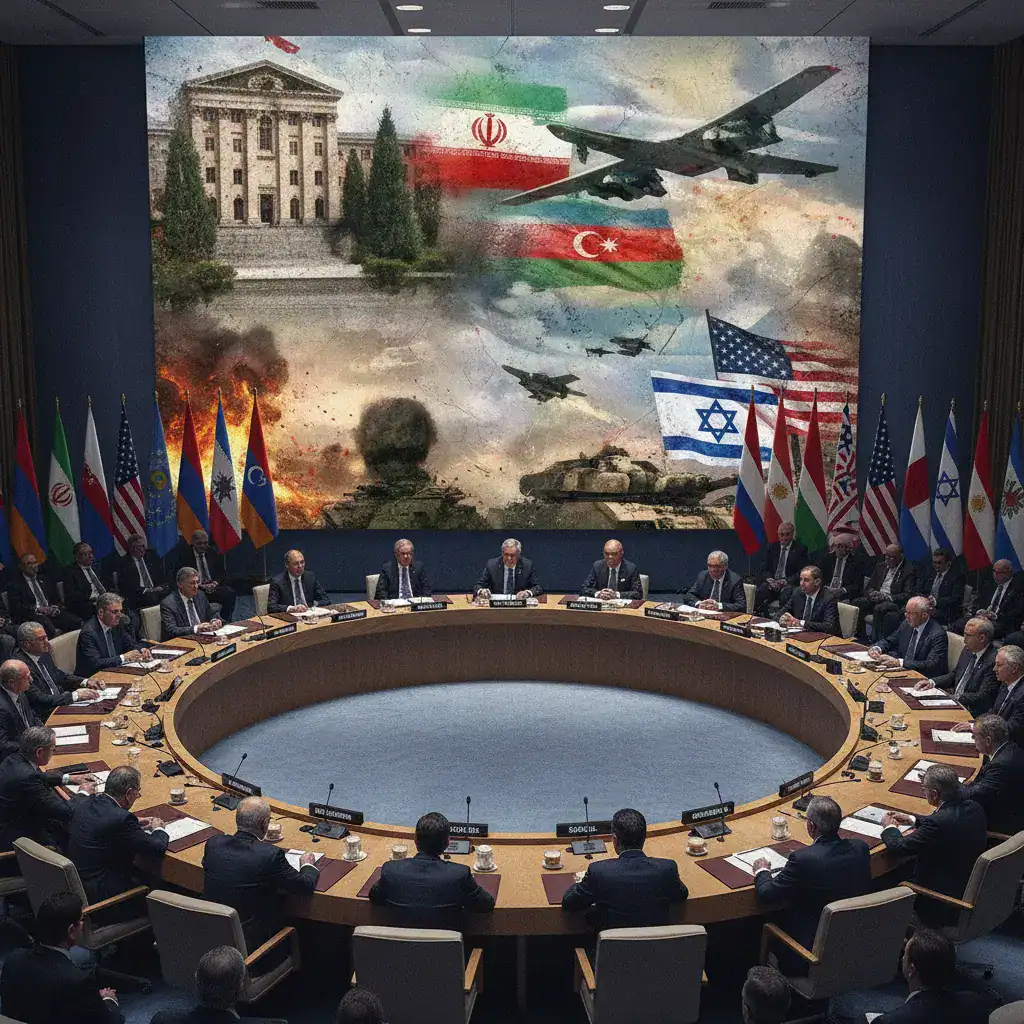
Yerevan, March 6 – Armenia’s Security Council convened yesterday, March 5, under the leadership of the Prime Minister, to address the regional security situation and the normal functioning of transport communications. The meeting took place against a backdrop of heightened tensions in the Middle East, with various diplomatic exchanges and military incidents reported across the region.
Key Discussions and Directives at the Security Council Meeting
During the Security Council session in Yerevan, participants discussed the complex security landscape in the region. Specific directives were issued to ensure the continuous and smooth operation of transport communications, a critical aspect of national and regional stability. The Prime Minister emphasized the importance of proactive measures to safeguard Armenia’s interests amidst evolving geopolitical challenges.
Diplomatic Engagements and Regional Developments
In a related development, the Foreign Ministers of Armenia and Bahrain held a telephone conversation to deliberate on the unfolding situation in the Middle East. Both parties exchanged views on recent developments and explored potential avenues for de-escalation. This diplomatic outreach underscores Armenia’s commitment to regional stability and its active role in international dialogues.
Simultaneously, the Foreign Ministers of Iran and Azerbaijan engaged in a phone call following an incident in Nakhchivan. Tehran refuted allegations of striking Azerbaijan and underscored the significance of maintaining good-neighborly relations. This exchange highlights the delicate diplomatic balance in the South Caucasus and the broader Middle East.
Adding to the regional complexities, the Foreign Ministers of Israel and Azerbaijan discussed the regional situation. Israel condemned Iran’s actions against Azerbaijan and affirmed its readiness to continue military operations. These statements reflect the deep-seated geopolitical rivalries and alliances shaping the region.
Escalating Tensions and Military Posturing
Azerbaijan temporarily closed its southern airspace near Iran for 12 hours, a decision made in response to the escalating regional tensions. This precautionary measure reflects the volatile security environment and the readiness of nations to respond to perceived threats.
The President of Azerbaijan declared that the strikes on Nakhchivan represent a significant turning point in Azerbaijani-Iranian relations. He stated that targeting civilian objects is considered an act of provocation and terrorism, signaling a potential hardening of stances between the two nations.
Iran reported that the death toll in the country due to military operations by Israel and the US has reached 1,230, according to official Iranian sources. This grim statistic underscores the human cost of the ongoing conflicts in the region.
A representative of the US Armed Forces disclosed that the American army utilized Iranian-developed drones, which were subsequently improved in the US, during military operations. This revelation points to the complex and often covert nature of military technology and its application in modern warfare.
International Reactions and Calls for De-escalation
Syrian authorities condemned the missile and drone attacks carried out against Turkey and Azerbaijan, asserting that such actions pose a threat to regional security. This condemnation from Syria highlights the interconnectedness of regional conflicts and the widespread concern over their destabilizing effects.
Archbishop Arshak Khachatryan, in a separate development, stated that the accusations attributed to him are false. He claimed that his detention was an attempt to exert pressure and intimidation. While seemingly unrelated to the regional security issues, this statement touches upon internal political dynamics and human rights concerns.
The ongoing developments in the Middle East and the South Caucasus necessitate continued vigilance and diplomatic efforts to prevent further escalation. The international community watches closely as regional powers navigate these turbulent times.
Source: https://auroranews.am/news/2026-03-05-anvtangvouthyan-khvorhrdi-nist-erevanvoum-merdzavvor-arevelqvoum-larvatsvouthyan-atch-ev-nvor-haytararvouthyvounner-taratsashrjanic