


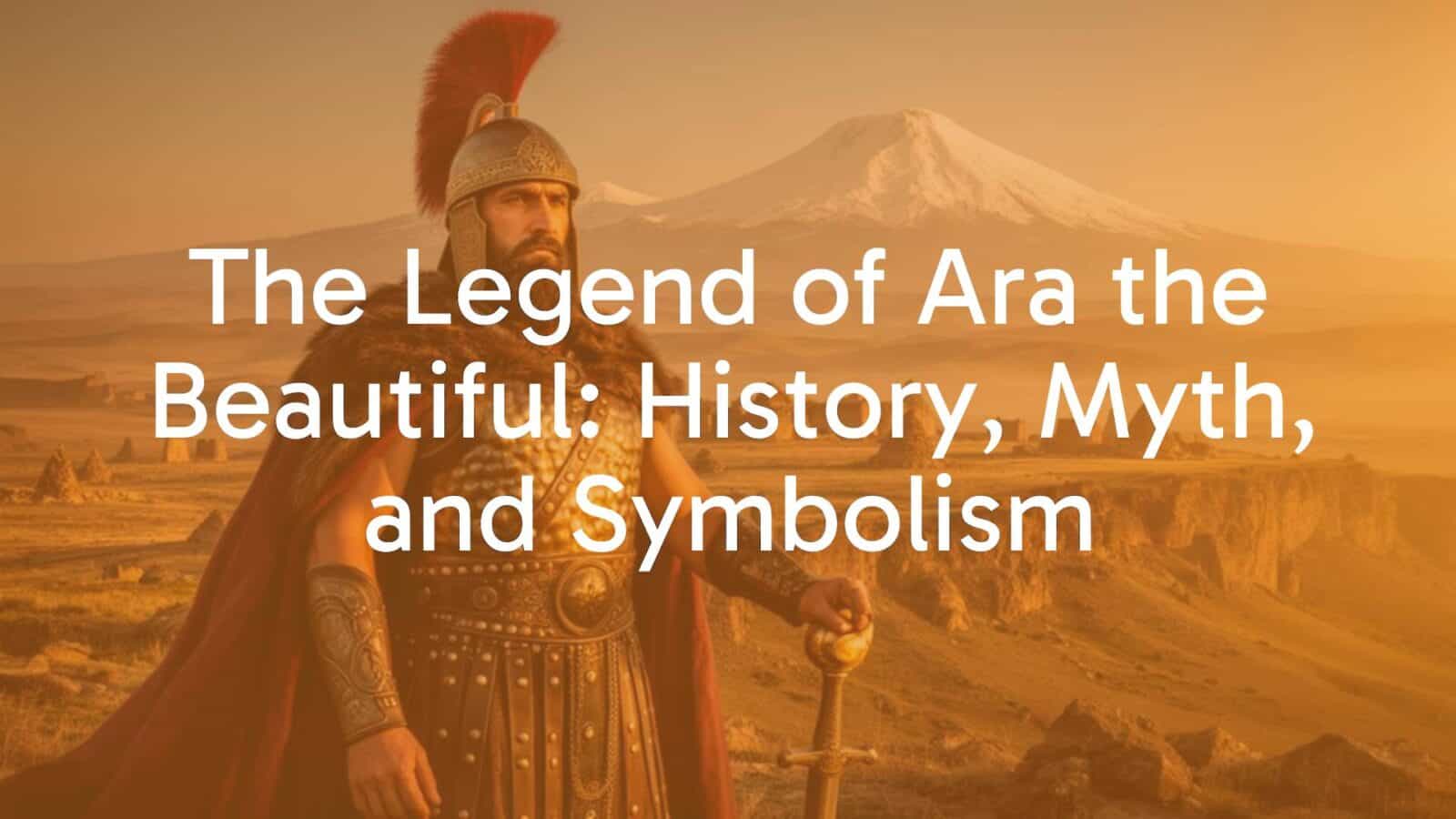
The legend of Ara the Beautiful is one of the most moving and lasting stories from the ancient Near East. It brings together early farming beliefs, struggles between empires, and ideas about right and wrong. At its center is the story of a virtuous Armenian king who rejects the advances of the Assyrian queen Semiramis. He chooses duty, loyalty, and the protection of his homeland over imperial wealth. The tale reflects the clash between local independence and foreign expansion. Its roots reach back to memories of the Bronze and Iron Ages in the Armenian Highlands. It can also be read as a memory of Urartian-Assyrian wars, a surviving seasonal story about death and return, and a key part of Armenian ideas about national identity.
The story is much more than a simple lesson about good and evil. It examines the limits of imperial desire, the final power of death, and the lasting strength of cultural memory. Through centuries of oral storytelling, historical writing, and new forms of art, Ara changed from a sun and farming god into an ideal image of Armenian kingship and moral courage. Following the many parts of this story shows how real history can blend with folklore and leave a lasting mark on the mountains, valleys, and shared life of the South Caucasus.
Who Is Ara the Beautiful?
In Armenian folklore, Ara the Beautiful, called Ara Gełec‘ik in Armenian, is remembered as a king whose grace matched his goodness. He is not shown as a land-hungry conqueror. Instead, he protects his country and remains faithful to his marriage vows. His story gives ancient Armenian tradition an emotional center, joining royal dignity with strong personal character.
Ara stands between the sacred and the ordinary. Later Christian writers described him as a good historical ruler of the fertile lands below Mount Ararat. Older mythic layers show him as a figure closely linked to nature, crops, and the return of the seasons. His death was believed to affect the larger fate of his people.
Ara as a legendary Armenian king
As a ruler, Ara the Beautiful is remembered for keeping Armenia peaceful, fertile, and well ordered rather than for launching large invasions. Old historical accounts describe him ruling a rich farming kingdom in the Araratian plain. His rule reflects an old Near Eastern idea of kingship: the king’s first duty is to guard the land, animals, and people, not to seek endless conquest.
Even when faced with the great power of the Neo-Assyrian Empire, Ara is shown as a defensive and principled leader. He refuses to accept foreign control hidden behind a proposed royal marriage. Instead, he gathers his forces to protect his country’s freedom. This image of a dignified king defending his borders against an empire shaped later Armenian ideas about royal courage.
The meaning of Ara’s name and other names
The name Ara, sometimes written Aray, offers clues about the old Indo-European roots of Armenian. Language scholars have linked it with the Proto-Indo-European root *h₂nḗr, connected with manly energy, life, and strength. Related Classical Armenian words include ayr, meaning man, and ari, meaning brave. The name also sounds similar to Ares, the Greek god of war, and to Iranian sun-related and mythic names from the ancient Iranian plateau.
Ara’s name is also closely tied to the sacred landscape and stories of the South Caucasus. It is linked by tradition to Mount Ararat, the province of Ayrarat, and Mount Aragats. Regional stories often remember the hero as Ari Armaneli, a folk-tale figure shut inside stone who later returns to life. Folklore also links his name to the white stork, aragil, seen as Ara’s sky messenger and a protector of farming lands.
Ara’s appearance, character, and heroic qualities
Ara’s beauty is not presented as physical charm alone. It is a visible sign of harmony and inner goodness. Old descriptions raise his appearance to the level of a masculine ideal, free from vanity and self-indulgence. His bright appearance reflects a character that cannot be corrupted, earning the respect of his subjects and of foreign rulers who hear about him.
His main heroic qualities are ethical ones: humility, loyalty, and complete devotion to his homeland. When the most powerful ruler in the ancient Near East offers him a share in a vast empire, Ara remains faithful to his wife, Nuard, and to his people. In Ara’s story, true courage does not come from a love of violence. It comes from patience, moral strength, and the ability to face a tragic end with dignity.
Ara’s Genealogy and Place in Armenian Tradition
In Armenian historical writing, family lines provide both a structure for the past and proof of continued national life. Ara does not appear as a lone hero. He belongs to a long line of fathers, rulers, and founders whose work shaped the Armenian Highlands. His family history acts like a sacred record of how the land was settled, protected, and farmed over many generations.
By carefully recording this line of descent, Armenian writers from ancient and medieval times supported the idea of native rule against the claims of neighboring empires. By placing Ara at the end of this early line, the tradition made his death more than a private tragedy. It became an event that changed the future of the whole nation.
Ara’s relationship to the Armenian royal line
Ancient genealogies say that Ara was the son of King Aram, a strong ruler whose victories were believed to have set the borders of early Armenia. Aram was praised for defeating foreign attackers, protecting the frontier, and giving his name to the land as other peoples knew it. Ara inherited a united kingdom and became the guardian of an already established and independent country.
Further back, Ara’s family line leads to Hayk, the legendary archer and founding father of the Armenian people. Hayk defeated the cruel giant Bel. The accepted line runs from Hayk through Aramaneak, Aramayis, Amasia, Gegham, Harmay, and Aram to Ara the Beautiful. As the eighth generation after Hayk, Ara stands at the height of this early age of legendary fathers. He also marks the gentle shift from the time of giants to the beginning of human history.

The role of genealogy in Armenian origin stories
Family records in early Armenian writing had an important political and cultural purpose. They placed native identity inside a biblical and classical account of human history. Medieval writers connected these early Armenian family lines with the migrations after the flood described in Genesis. They traced Hayk and his descendants back through Japheth to Noah. In this view, Ara was not an unusual pagan figure but a righteous prince from an ancient royal family established by God.
These origin stories also acted as claims to land and political independence. Each ancestor in Ara’s line was linked with the founding of provinces, the building of forts, or the naming of rivers, mountains, and plains. Following Ara’s descent through these legendary fathers confirmed the old and lasting bond between the Armenian people and their homeland.
Ara’s connection with Armenian identity and national memory
Ara the Beautiful holds a special place in Armenian memory. Hayk, the founding father, represents revolt against foreign oppression. Ara represents the moral and emotional strength of a people facing the plans of larger empires. His refusal creates a lasting theme: cultural, political, and spiritual identity must not be traded for outside rewards.
Over many centuries, the Armenian Highlands faced invasion and foreign rule. During these periods, the memory of Ara offered a strong answer to outside power. His story told later generations that personal honor, love of home, and self-sacrifice were worth more than submission to an empire. He remains an image of quiet but firm national pride.
The Historical Roots of the Legend of Ara the Beautiful
Behind the myth, the story of Ara the Beautiful holds memories of real politics and warfare in the ancient Near East. During the first millennium BCE, the Armenian Highlands were a place of conflict between the local kingdom of Urartu, known as Ararat in the Bible, and the growing Neo-Assyrian Empire. Repeated invasions, long sieges, and diplomatic offers formed the historical background from which the legend likely grew.
For centuries, singers called gusans kept these painful political memories alive and changed them through retelling. Over time, real kings, forts, and battles became part of a larger story about forbidden love, resistance to empire, and tragic loss.
Movses Khorenatsi and the main written account
The best-known written version appears in the fifth-century work History of the Armenians by Movses Khorenatsi, honored as the “Father of Armenian History,” or Patmahayr. Khorenatsi drew on the oral stories of the gusans, who performed with lyres. He put the epic into written form and created a story that joins historical ideas with strong mythic meaning.
Khorenatsi tells the story in a calm and thoughtful style. He includes magical details, such as the queen’s sorcery and her calls to supernatural beings, while also showing a questioning attitude. He gives the names of the main figures, describes their family ties, and identifies the places connected with the war. In this way, he saved an old oral tale from being lost and placed it within Armenian classical writing.
Separating historical evidence from legendary tradition
Modern history and archaeology suggest that the epic grew from real events in the Iron Age. Urartian inscriptions and Assyrian royal records show long political and military competition between northern and southern powers from the ninth to the seventh centuries BCE. Scholars have often pointed out that Ara’s legendary father, Aram, has a name similar to Arame, the first known king of a united Urartu, who ruled in the ninth century BCE.
Some historians, including David Marshall Lang, have suggested that Arame and Ara may preserve memories of the same early Urartian rulers. Others, such as M. Chahin, have proposed possible links with Inushpua, the son and co-ruler of the Urartian king Menua. The personal meetings between Ara and the Assyrian court belong to folklore. The larger setting, however, is supported by history: a Highland kingdom resisting the armies and political demands of Nineveh.
Semiramis, Sammu-Ramat, and the transformation of history into myth
The legendary Semiramis, called Shamiram in Armenian, is mainly based on the historical Assyrian queen Sammu-ramat. She lived at the end of the ninth century BCE and ruled as regent from about 811 to 806 BCE. After her husband, King Shamshi-Adad V, died, Sammu-ramat governed for her young son, Adad-nirari III. Her short period of rule as a woman holding the highest authority in an empire that stretched from the Persian Gulf to the Caucasus amazed the ancient world and became the starting point for a long-lasting legend.
Later writers across the Mediterranean and Near East enlarged Sammu-ramat’s real achievements. These achievements are supported by royal monuments found at Assur and small statues from Nimrud. Classical authors such as Herodotus and Diodorus Siculus helped spread her fame. Armenian tradition gave her a more complex role. Instead of showing her only as a great builder, it presented her as a powerful queen and magician whose uncontrolled desires brought disaster to the Highland kingdom.
The Story of Ara and Semiramis
The classical story of Ara and Semiramis has the force of a great tragedy. It centers on a clash between two rulers with very different forms of power. One is a queen with enormous imperial authority. The other is a quiet king who will not give up his principles. A distant attraction becomes a political demand and then turns into a military disaster on the plains of Armenia.
The tale moves from royal offers to war, death, grief, and a strange attempt to hide the truth. It also explores guilt, desperation, and the use of fear to control people. This dramatic pattern has held the attention of storytellers, poets, and playwrights for more than two thousand years.
How Semiramis became fascinated by Ara’s beauty
According to the old story, Queen Semiramis had heard for years about Ara’s remarkable beauty, grace, and noble manner while she lived in Nineveh. Her interest grew into a powerful obsession that filled her court. After her husband, King Ninus, died, she was free to follow her wishes without opposition from a husband.
Semiramis wanted to join the Armenian king to the Assyrian royal house. She sent messengers to his court with gold, jewels, rich gifts, and official offers. Their message sounded like an invitation but carried a clear demand: Ara could come to Nineveh, marry the queen, and share the rule of the Assyrian Empire. At the least, he was expected to give in to her wishes and return home with imperial wealth.
Ara’s refusal and the threat of war
Ara was not moved by promises of riches, comfort, or a share in a great empire. He remained devoted to his wife, Queen Nuard, also called Nvard, and to their young family. He rejected each message from the foreign court and repeated that his first loyalties were to his people, his country, and the marriage promises honored by his ancestors.
The messengers were sent back more than once, and the expensive gifts returned untouched to Nineveh. Semiramis was furious. She saw Ara’s refusal as a direct challenge to her royal power. Her desire became anger, and she called up the armies of Assyria. She decided to take by force what diplomacy and courtship had failed to win.
The battle between Ara’s Armenian forces and Semiramis
The Assyrian army crossed rough mountain ranges and moved down into the fertile plains of the Armenian Highlands. Tradition places the main battle on the Plain of Ara, often linked with the Araratian plain or the Emerald Valley near Mount Ara. Semiramis still wanted Ara alive, despite her anger. She ordered her commanders to capture him without harming him.
War did not follow her plan. Armenian soldiers fought fiercely to defend their king and homeland, pushing back wave after wave of Assyrian troops. During the violent battle, an arrow struck Ara in the chest. Local stories sometimes say that the arrow was poisoned and fired by one of Semiramis’s jealous lovers. Ara fell and died on the land he had chosen to protect.
Ara’s death, the attempted revival, and differing versions of his fate
After the fighting ended and the Armenian army withdrew, Ara’s body was found on the bloody field and taken to Semiramis. She was overcome with grief and feared revenge from the surviving Armenians. Unable to accept his death, she ordered the body carried to the roof of a high fortress. There she used spells and prayers, calling on divine dog-like spirits to come down and lick the wounds, hoping they would return him to life.
As the summer heat caused Ara’s body to decay, Semiramis had to face the failure of her plan. She feared a wide revolt, so she had the body thrown into a deep pit. She then dressed one of her handsome lovers in Ara’s royal armor and presented him to the people. She claimed that the gods had heard her prayers and brought the king back to life, calming the Armenian army. Other oral traditions, later recorded by writers, say that the magical revival really worked or that Ara returned in spirit and continued to guard his land forever.

Mythological Parallels and Earlier Inspirations
Comparative mythology shows that the story of Ara the Beautiful may preserve an older Near Eastern myth about life, death, and the return of nature. Before the tale was presented as the history of human kings and queens, its main pattern may have been a sacred story about seasonal change. Ara represents an Armenian form of a common figure: a young and beautiful male linked with earth, crops, and the power of the sun. His early death brings cold or dryness, while his return promises new life.
This older layer connects the legend with religious practices from Mesopotamia, the Levant, and Anatolia. Its main pattern resembles seasonal ceremonies followed by farming societies for thousands of years.
Ara and the dying-and-rising hero motif
Scholars of religion often see Ara as a version of the “dying-and-rising” god. In such stories, a young and exceptionally handsome man, often the son or lover of a powerful goddess, dies violently while still in his prime. Similar patterns appear in the Mesopotamian story of Inanna, or Ishtar, and Dumuzid, also called Tammuz; in the Phoenician and Greek story of Aphrodite and Adonis; and in the Phrygian rites of Cybele and Attis.
Armenologist James R. Russell has pointed out that Khorenatsi’s account contains clear traces of the Cybele and Attis story. In that myth, a passionate goddess mourns a dead young man and tries to overcome the final power of death. Ara’s death during the hot season and the attempt to restore his body with supernatural dogs resemble old fertility rites in which the earth’s life rests beneath the soil until the seasons bring it back.
Connections to Hayk, Bel, Vahagn, Astghik, and ancient Near Eastern traditions
Ara’s story is closely connected with the wider body of Armenian mythology. Mythologist Armen Petrosyan, using Georges Dumézil’s idea of three main functions in Indo-European myths, argues that Hayk, Aram, and Ara form a symbolic group. Hayk represents ancient royal authority, Aram represents military power, and Ara the Beautiful represents farming, physical plenty, and the beauty that gives life. In this pattern, Ara is the force that feeds the earth and supports human society.
Other stories connect Ara and Semiramis with Armenian divine pairs such as Vahagn, the thunder god who kills dragons, and Astghik, the goddess of love, water, and beauty. Some scholars believe that Semiramis took on the role of an older Armenian mother goddess. Over time, this figure may have become divided among Anahit, Astghik, and Nane. Through these links, Ara’s refusal and death echo older battles between the native gods and the gods of foreign powers.
What Does Ara the Beautiful Symbolize?
The legend has lasted partly because it carries many possible meanings. It is more than a record of an old war. It also speaks about personal ethics, national freedom, love, political power, and human weakness. Each major character and event reflects a problem that people in many periods can understand.
As the story passed from one generation to another, its meanings grew. Different audiences saw in Ara their own struggles with cultural pressure, imperial rule, and the danger of giving up spiritual or national identity.
Beauty as moral strength rather than physical appearance alone
In Armenian tradition, the title Geghetsik, meaning the Beautiful, refers to much more than a pleasing face. Ara’s beauty is a moral quality. It shows spiritual balance, honesty, and honor. His handsome appearance matters because it reflects an inner character that remains firm even under great pressure.
This idea differs from the shallow beauty often praised in royal courts. Ara’s beauty grows from self-control, humility, and truth. He does not use his appearance to control others or gain rewards. His beauty shines as a sign of good character, showing that inner nobility matters more than physical appearance.
Ara’s refusal as a symbol of sovereignty and personal honor
Ara’s rejection of Semiramis’s marriage offer is a clear statement of national freedom. If he accepted the Assyrian queen, Armenia could become a province of the empire. Its political independence, religious customs, and old traditions could be lost. Ara’s decision says that a nation’s identity and freedom must not be exchanged for comfort or imperial wealth.
On a personal level, his refusal also represents honor and faithfulness in marriage. He chooses his promises to Queen Nuard over the attraction of ruling a vast empire. His example presents kingship as a duty based on honesty, limits, and loyalty to the community, not on an endless desire for greater power.
Love, desire, and political control in Semiramis’s pursuit
In the Armenian version of the story, Semiramis shows how love can become a form of conquest. Her desire for Ara does not include equal respect or concern for his wishes. She treats another ruler as a rare possession that she can buy, control, and bring into her empire. Once he refuses, her desire quickly becomes an attack, revealing the force hidden beneath her flattering offers.
This pattern shows how powerful states can hide plans for expansion behind promises of friendship, partnership, or shared prosperity. Semiramis represents an empire that cannot accept a free and separate neighbor. Ara’s refusal exposes the weakness of such offers and shows that real affection cannot exist where one side uses force.
Death, attempted resurrection, and the limits of human power
The scene on the windy fortress roof brings the story face to face with death. Semiramis commands huge armies, rules great cities, and knows magical practices, yet she cannot defeat the fact that Ara has died. Her authority cannot place life back into his body.
This scene reflects on the limits of earthly power. Empires can cross borders, destroy forts, and kill their enemies, but they cannot defeat death or restore what violence has taken away. Semiramis’s deception, in which she dresses a lover in Ara’s armor, shows how weak absolute power can become when it meets the final silence of death.
Places and Cultural Memory Connected to Ara
The legend of Ara the Beautiful is found not only in old books. It is also tied to the land of the Armenian Highlands. Communities have connected parts of the story with valleys, mountains, and old settlements near them. In this way, geography and legend support each other, and each generation can see the story in the surrounding landscape.
These places make the story more than an idea in a book. The land itself became a lasting record of the king’s death and the queen’s grief.
Ara Lezk, Mount Ara, and the geography of the legend
The best-known landmark is Mount Ara, or Arayi Lerr, an extinct multi-stage volcano north of Yerevan. From several points on the Araratian plain, its rounded ridge looks like the shape of a man lying at rest. The head, chest, and knees seem to stand out against the sky. Popular tradition says that the mountain is Ara, kept forever in stone at the place where he fell.

Aralez spirits and local traditions of reviving fallen heroes
The magical center of the story is formed by the Aralez, or Haralez, beings from the oldest layers of Armenian mythology. They were imagined as winged creatures with the shape of dogs. People believed that they came down from the sky onto battlefields, licked the wounds of brave dead heroes, removed poison from their bodies, and returned them to life. Early writers connected the name Aralez with lizel, meaning “to lick.”
Belief in these healing dog-like beings continued well into the Christian period and appeared during times of national danger. The fifth-century work Buzandaran Patmut‘iwnk‘, or Epic Histories, says that after the heroic commander Mushegh Mamikonian was killed, his family placed his cut body on top of a tower. They waited in the hope that the Aralez would come and restore him. This act shows how strongly the idea of dogs bringing dead warriors back to life had become part of local military custom.
Ara the Beautiful in Literature, Art, and Popular Culture
For many centuries, the story of Ara and Semiramis has inspired Armenian writers, artists, and theater makers. Each period returned to the legend during its own struggles and used its characters to discuss national identity, desire, and memories of the past.
Through early modern books, paintings, plays, and dance, Ara and Semiramis changed from figures in an old folk story into rich symbols of human passion, loss, and endurance.
Ara in Armenian historical writing, folklore, and the arts
After Khorenatsi’s account, medieval writers such as the tenth-century historian Tovma Artsruni continued to record local stories about Ara and the fortress of Lezk near Lake Van. The tale also became part of village folklore. Ara was reshaped into fairy-tale heroes such as Ari Armaneli. His memory was also linked with the national epic Daredevils of Sassoun. In that epic, Little Mher enters a stone cave and waits for a future return, echoing Ara’s sleep, death, and hoped-for rebirth.
After Armenia became Christian, parts of Ara’s farming and protective worship joined popular devotion to Saint Sargis the General. Saint Sargis was seen as a brave and handsome warrior saint connected with young people, love, and protection. He took on some of the emotional and religious role once held by the old hero. In this way, respect for brave and virtuous masculine beauty continued through the medieval period in Christian form.
Modern portrayals of Ara and Semiramis
Modern artists returned to the story with new energy. In 1899, the historical painter Vardges Sureniants completed Shamiram Mourning the Body of Ara the Beautiful. The painting shows the Assyrian queen in heavy, richly decorated Mesopotamian clothing as she looks down at the calm, pale body of the Armenian king. Her face expresses regret and desire that can never be fulfilled. The scene brings together imperial pride and the dignity of a dead hero.
During the twentieth century, the poet and playwright Nairi Zarian gave the tale a strong dramatic form in his tragedy Ara Geghetsik. Written during a troubled period, the play turned the legend into a clear statement against imperial rule and cultural absorption. It celebrates a small nation that refuses to lose itself. Later, writers such as Zorair Khalapyan examined the complicated feelings between the two rulers. Stage works, including Grigor Yeghiazaryan’s well-known 1982 ballet, carried Ara’s refusal and the flight of the Aralez to theaters in many countries.
Why the Legend of Ara the Beautiful Still Matters
In a time of fast globalization, weaker local cultures, and changing political borders, the legend of Ara the Beautiful still speaks to people. It is not only an old tale for libraries. It raises lasting questions about human life and the survival of nations. The ancient king reminds readers that moral limits and national dignity can matter more than the short-term reach of an empire.
The story remains a living myth rather than a simple record of the past. It questions the idea that power gives a ruler the right to control others or that small nations must disappear into the culture of larger states. Ara offers an image of resistance based on love for one’s people and homeland instead of a desire for violence.
Reading the legend as history, myth, and cultural symbolism
The legend can be read on three connected levels. As history, it keeps alive memories of Iron Age struggles between Urartu and the growing power of Nineveh. It recalls rulers who defended their Highland valleys. As myth, it follows the old pattern of life, death, and return. It expresses human fears about the fertility of the soil, the changing seasons, and the weakness of life.
As a cultural symbol, Ara’s story offers a guide to freedom and personal faithfulness. It says that real beauty depends on moral strength and that courage can be measured by what a person is willing to give up to protect what matters. The links between landscape, oral storytelling, and classical writing reveal more than the memory of a dead king. They reveal the lasting spirit of a culture that has survived many centuries of conflict while holding on to its honor beneath the watchful shape of Mount Ara.













Leave a comment