
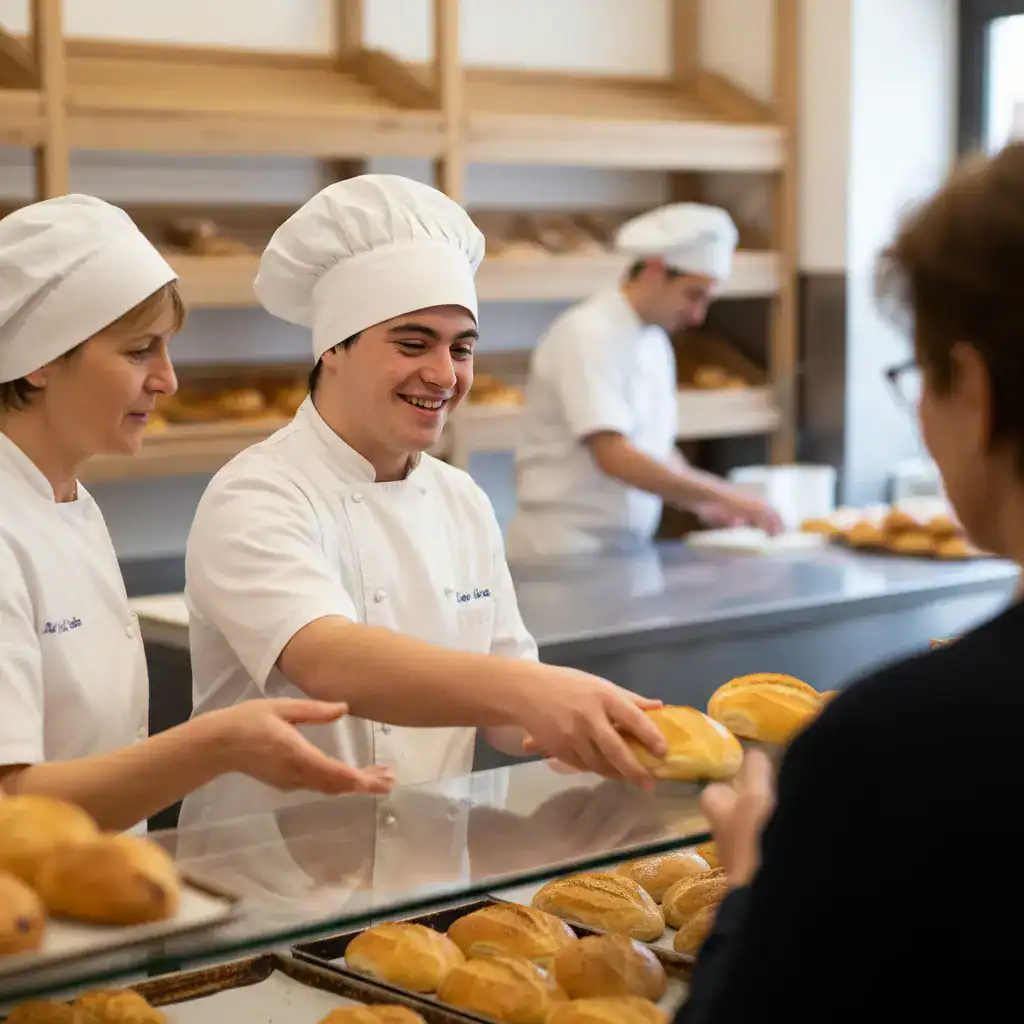
The aroma of freshly baked bread and the rich scent of coffee now fill the air in the heart of Gyumri, Armenia, signaling more than just a new culinary establishment. ‘Aregak’, the region’s first inclusive bakery-café, has become a beacon of hope and opportunity, transforming lives and challenging societal perceptions of disability.
A Dream Forged in Necessity: The Genesis of ‘Aregak’
The story of ‘Aregak’ began not with a business plan, but with a profound human need. Tigranuhi Hakobyan, the project manager, recounts the journey from the ‘Emili Aregak’ program, which since 2008 has focused on caring for children with disabilities, to the realization of this innovative social enterprise. While providing care was crucial, the challenge of securing employment for these young adults once they transitioned out of the program became increasingly apparent.
“In 2016, the European Union announced a call for strengthening civil society organizations,” Hakobyan explains. “We gathered our staff and discussed what this could mean for ‘Emili Aregak.’ We thought of establishing a space in Gyumri that would allow people with disabilities to showcase their abilities, to create a bakery where we could demonstrate that quality bread is baked in hygienic conditions by our staff. The other aspect was to have a café where handicrafts made by people with disabilities would be displayed.”
This vision, born from a desire to address high unemployment rates in Gyumri, particularly among individuals with disabilities, received substantial funding from the European Union, the Austrian Development Agency, and Caritas Austria. The inclusive bakery-café opened its doors in September, quickly becoming a beloved fixture in the community.
Grisha’s Coffee: More Than Just a Beverage
Among the first employees of ‘Aregak’ is 21-year-old Grisha Khachatryan. For Grisha, who has a disability, this is his first job. In a city where finding employment is a challenge for anyone, it was nearly impossible for him. He balances his work at ‘Aregak’ with his studies at Gyumri’s fourth vocational school, arriving after classes to prepare and serve coffee until evening.
“It’s good. I turn on the coffee machine, brew the coffee,” Grisha says simply, listing the various types of coffee he can prepare – cappuccino, espresso, americano, and even iced coffee – with a sly smile. His customers are delighted with his creations. Tigranuhi Hakobyan proudly shares anecdotes, including one from the Deputy Prime Minister Tigran Avinyan, who reportedly said, “One can come to Gyumri just for Grisha’s coffee.”
Grisha recalls serving cappuccino to the Deputy Prime Minister himself. While he enjoys making coffee, his true passion lies in cooking. “One day I saw the girls take Grisha to the kitchen, and he was preparing croissant dough. I felt he loved rolling croissant dough,” Hakobyan recounts, a hint of concern in her voice. “That saddened me, because he makes excellent coffee, and he’s irreplaceable in this job.”
Mikael’s Journey: From Care Center to Kitchen Assistant
The story of 20-year-old Mikael Sahakyan was a key catalyst in the creation of ‘Aregak’. A former beneficiary of ‘Emili Aregak’, Mikael struggled to find employment after leaving the care center. He had studied cooking at a vocational school and needed practical experience, but faced rejection from several establishments.
“When Mikael went to vocational school to study cooking, he needed to do an internship. He and his mother went to several institutions but were rejected,” Hakobyan explains. “His mother came back to ‘Aregak’ with Mikael. We were happy that a beneficiary from ‘Aregak’ had moved on, but he had, in fact, returned. He was forced to do his internship with us.”
Mikael’s experience, along with that of others, underscored the urgent need to create job opportunities. “Gyumri is a city with the highest poverty rate, and unemployment is high. If you want to work here, you have to create that work,” Hakobyan emphasizes. Today, Mikael works in the kitchen at ‘Aregak’ as an assistant to the baker, Anahit.
His workday begins at 10:00 AM and ends between 3:00 PM and 4:00 PM. Mikael says he enjoys his work, finding it easy and not tiring. When asked if he had wanted to work before, he simply replies, “Yes, very much.”
Anahit: A Mother’s New Beginning
Anahit Grqikyan, 42, is another testament to ‘Aregak’s transformative power. The mother of Edgar Kalabyan, a beneficiary of the ‘Emili Aregak’ center, Anahit had never worked outside the home, dedicating her life to caring for her son. ‘Aregak’ is her first workplace.
“This is a new opportunity for me,” Anahit shares. “Since everyone here is familiar, I work in a familiar environment, with understanding people next to me, it’s very easy to work. Before this, I used to bake pastries at home, and I had asked if there was an opportunity for me to work here, and my wish came true.”
Anahit believes that more such workplaces are needed in Gyumri, given the high unemployment rate and the difficulties faced by people with disabilities in finding jobs.
Beyond Bread: A Holistic Approach to Inclusivity
The EU’s significant financial contribution, covering approximately 70% of the project, extends beyond just the bakery and café. ‘Aregak’ is a multi-faceted initiative encompassing five key components: handicrafts, public awareness campaigns, institutional cooperation, and gardening.
“We place great importance on the cooperation component, thanks to which Grisha and other young people came to the ‘Aregak’ center and participated in various training courses,” Hakobyan notes. “People with disabilities are already coming here, asking us, ‘How can you help?’ We have become a resource, an information center for the city’s residents. We want to become an exemplary employer.”
Hakobyan’s message is clear: “Give us space, and we will show our capabilities. People need to be given the opportunity to create and innovate.”
A Domino Effect for an Inclusive Gyumri
At the opening of the inclusive bakery-café, EU Ambassador Piotr Switalski underscored the importance and applicability of this initiative. He emphasized that such projects contribute to the formation of an inclusive society. While not creating a large number of jobs, he believed it could have a domino effect, inspiring similar initiatives in other cities.
Switalski also highlighted that the goal of social entrepreneurship is not just income and money, but the strengthening and resilience of the community. “We would like to see Gyumri as an example of an inclusive city,” the EU Ambassador had said.
Shirak Deputy Governor Sofia Hovsepyan, who has been involved with the project from its inception, echoed these sentiments. She attests to the program’s crucial mission, noting the increasing number of visitors to the inclusive bakery-café each day.
“This can be considered the best program, not only for the city but for the entire region and the republic. We need to change our mindset, and inclusivity must become our most important way of thinking, not just mere words,” Hovsepyan states. “And from that perspective, this is one of the best examples. In a very short period, this initiative brings people from different parts of the world to Gyumri.”
Visitors, she adds, are amazed and appreciate the abilities of these individuals, who were once perceived as incapable due to their difficulties. “Today, they show that with desire, a person can do anything,” she concludes.
A City Rebuilding, One Loaf at a Time
The devastating earthquake of December 7, 1988, claimed 25,000 lives in Armenia, with Gyumri being the most severely affected city, almost entirely destroyed. The earthquake left a significant number of people with disabilities, making the EU’s program all the more vital for the city’s recovery and development.
In the quiet hum of the coffee machine and the rhythmic kneading of dough, Gyumri is not just baking bread; it is baking a more inclusive future, one filled with dignity, opportunity, and the sweet taste of success for all its citizens.
Source: https://euneighbourseast.eu/hy/news/stories/evramiutyan-ajakcutyamb-gyumrin/