
Yerevan, September 1, 2026 – Armenia is at a pivotal juncture, navigating complex political and economic landscapes. The nation is observing significant developments in its foreign policy, with particular attention to its relationships with key international partners, alongside internal political movements and economic analyses.
Foreign Relations and Strategic Partnerships
Discussions around Armenia’s strategic partnerships continue to dominate the political discourse. Foreign Minister Mirzoyan stated that Russia is “more than just a strategic partner” for Armenia, emphasizing the multifaceted nature of their relationship across legal, political, and economic spheres. This declaration comes amidst ongoing debates and differing viewpoints regarding the depth and future direction of this partnership.
Conversely, Moscow has expressed disagreement with Prime Minister Pashinyan’s assessment of the strategic partnership between Russia and Armenia. Despite this, the Kremlin has confirmed an upcoming meeting between Russian President Vladimir Putin and Armenian Prime Minister Nikol Pashinyan in Bishkek, on the sidelines of the SCO summit. This meeting is anticipated to address the nuances of their bilateral relations and potentially iron out existing discrepancies.
Adding to the complexity, the Ukrainian National Agency for the Prevention of Corruption (NAPC) has commented on Armenia’s shifting stance, suggesting that Armenia is “finally turning its back on Russia.” This statement highlights the growing international perception of Armenia’s evolving foreign policy and its efforts to diversify its alliances.
Economic Implications and Regional Alliances
The potential withdrawal of Armenia from the Eurasian Economic Union (EAEU) has become a significant topic of economic analysis. Experts predict that such a move would primarily impact the export of three product categories from Armenia: alcohol, flowers, and fish. This highlights the intricate economic ties within the EAEU and the potential reorientation of Armenia’s trade policies.
In other economic news, the US Secretary of the Treasury indicated that economic pressure on Iran could persist for “weeks and even months,” a development that could have regional economic repercussions, including for Armenia, given its geographical proximity and trade relations.
The Armenian dram (֏) has shown some fluctuations against major currencies. The USD is currently trading at 364.47 ֏ (▲), the EUR at 422.71 ֏ (▼), and the RUB at 4.21 ֏ (▼). These exchange rates reflect the broader economic trends and market sentiments affecting the region.
Domestic Politics and Social Developments
Domestically, the political scene is also active. A public committee for the defense of Gagik Tsarukyan, leader of the “Prosperous Armenia” party, has been established. This move indicates ongoing political maneuvering and support structures for prominent political figures.
Further, Konstantin Zatulin, a Russian State Duma deputy, extended birthday greetings to Robert Kocharyan, leader of the “Armenia” alliance and former President, underscoring continued Russian engagement with Armenian political figures.
In a related development, a press conference was held at the office of Armenia’s second president, Robert Kocharyan, on August 31, 2026, at 12:14 PM. Details of the press conference are yet to be fully disclosed but are expected to cover pressing national issues.
Discussions around constitutional amendments and the potential handover of Tigranashen are also gaining traction, with Anna Grigoryan stating these are “the first points of Pashinyan’s program.” These topics are likely to shape future political debates and public discourse.
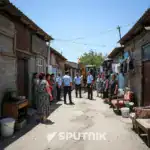
Social issues are also in focus, with reports of residents in Shengavit being evicted from their homes due to demolition. One resident expressed distress, stating, “They came and said they are demolishing the house. For three days, I haven’t slept or eaten.” This highlights the social impact of urban development projects.
Furthermore, two individuals were detained during an aeration event, one of whom reportedly hit a police car, indicating instances of public unrest or protest.
International Engagements and Regional Diplomacy
Beyond the immediate region, President Aliyev of Azerbaijan and President Lukashenka of Belarus held a meeting in Bishkek, while Aliyev also met with the President of Iran. These high-level meetings signify ongoing diplomatic efforts and regional cooperation initiatives that could influence the broader geopolitical landscape affecting Armenia.
Armenia is also exploring new defense capabilities, with reports suggesting it could become the first customer for Pinaka missiles with a flight range of 120 km. This potential acquisition indicates a focus on strengthening national defense and diversifying military partnerships.
Additionally, new flight routes from Shirak Airport have been announced, pointing to efforts to enhance connectivity and potentially boost tourism or trade.
The Armenian-Indian cooperation is also set to develop in new areas, as indicated by Prime Minister Modi’s Armenian-language post. This suggests a deepening of bilateral ties and potential for collaboration in various sectors.
In cultural news, portraits of 19 Armenian political prisoners held in Baku are being exhibited in Paris, drawing international attention to humanitarian concerns and the ongoing Nagorno-Karabakh conflict.
The news landscape in Armenia remains dynamic, with a confluence of political, economic, and social developments shaping its trajectory in late 2026. The coming weeks are expected to bring further clarity on many of these evolving situations.